
Why AED pad position matters and how to use an AED
The correct positioning of AED pads is really important. It has been shown to be critical in ensuring the maximum electric shock flows directly through the heart muscle (the myocardium). If the pads are incorrectly places, the shock can bypass the heart muscle or arc over it. This will dramatically reduce the chance of the heart returning to a normal rhythm after a shock is given.
Why AEDs save lives:
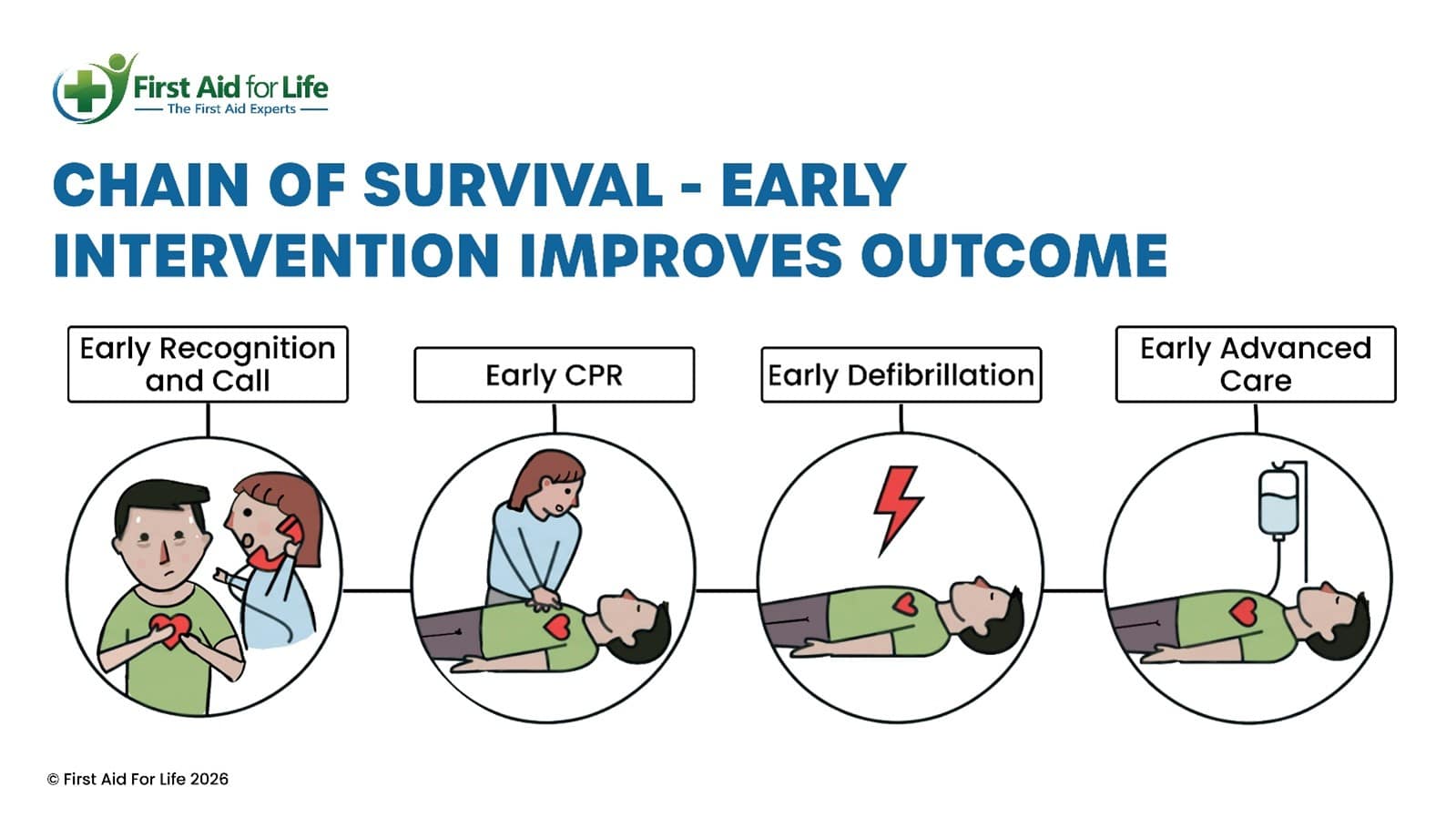
Swiftly using an AED if someone has a cardiac arrest has been proven to dramatically increase the chances of survival. If someone has a cardiac arrest and is in a shockable rhythm, if an AED is deployed within 3 minutes of their cardiac arrest, their chances of survival jump from 6% (with just CPR) to 74%. For every minute’s delay there is an 8 -10% drop in the survival rate – therefore every second counts! It is also helpful to understand exactly how an AED works.
CPR remains critical –
The introduction of AEDs has hugely increased the survival rate for someone experiencing a cardiac arrest. However quality CPR is essential to ensure that the heart and brain continue to receive oxygenated blood.
Why Correct Pad Placement Matters
It’s easy to underestimate how much difference correct pad placement makes. The heart is not centred in the chest; it sits slightly to the left, deep behind the breastbone. To deliver a successful shock, the AED needs to send a controlled electrical current through the heart muscle. If the pads are too close together, separated by clothing, or applied over a very hairy chest, the current may not flow properly, and the shock may not be as effective.
Research continues to show that good pad placement improves defibrillation success and survival rates. The 2025 RCUK guidelines place renewed emphasis on training people not only to start CPR quickly but also to place AED pads correctly and confidently.
During a cardiac arrest, the body’s normal electrical system fails, and the heart can go into a chaotic rhythm called ventricular fibrillation. The AED’s shock helps reset this system, allowing the heart to resume a normal rhythm. Proper pad placement ensures that this reset actually reaches the heart muscle rather than dispersing through other tissues.
In short, where the pads go really does matter, it’s a small step that has a huge impact
How do we remember where to put the pads in an emergency?
AED pads have illustrations to show where the pads should be positioned. However, most of these illustrations are suboptimal and some are wrong, so please don’t rely on these diagrams.
Here’s how to position them correctly:
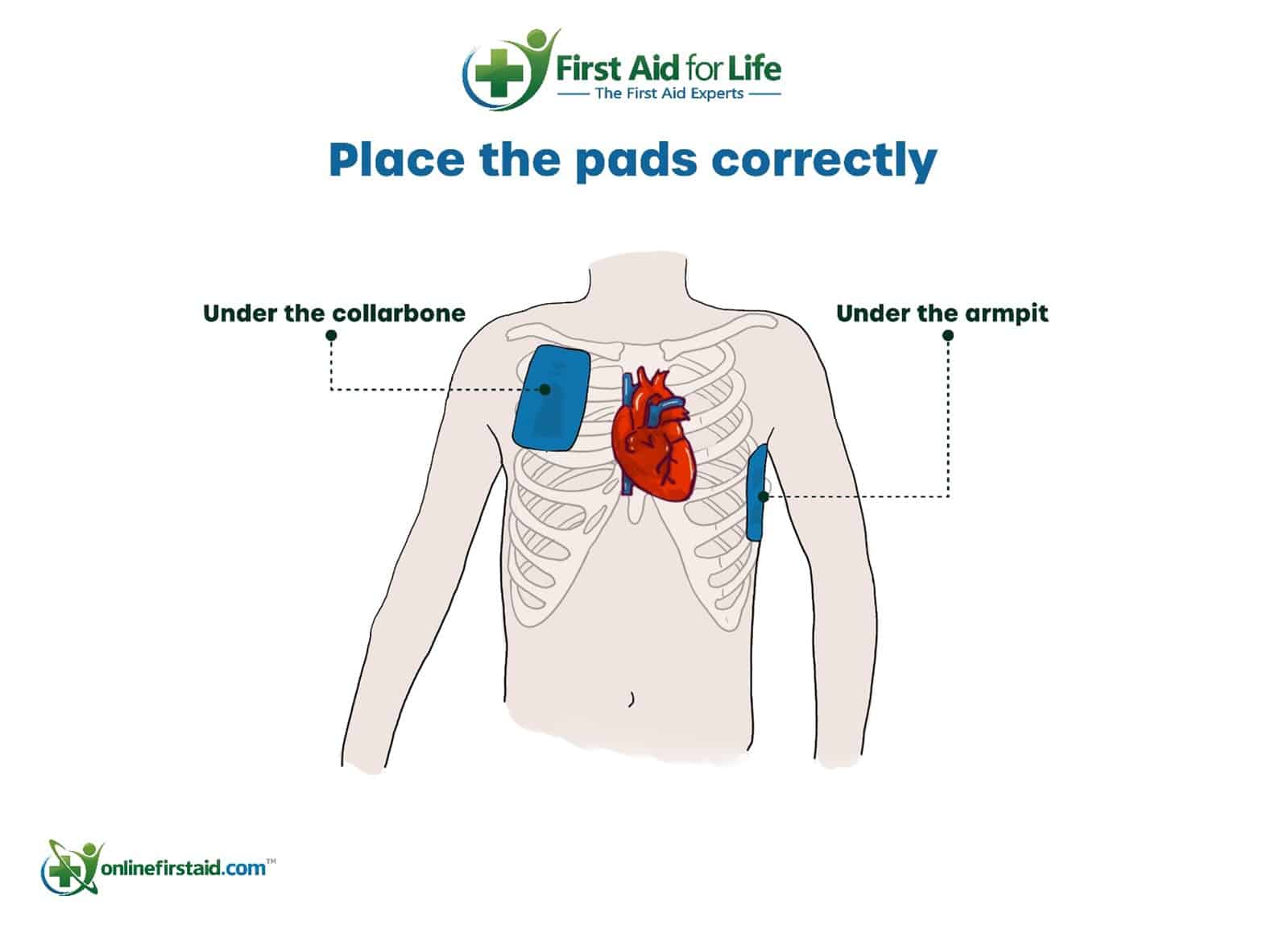
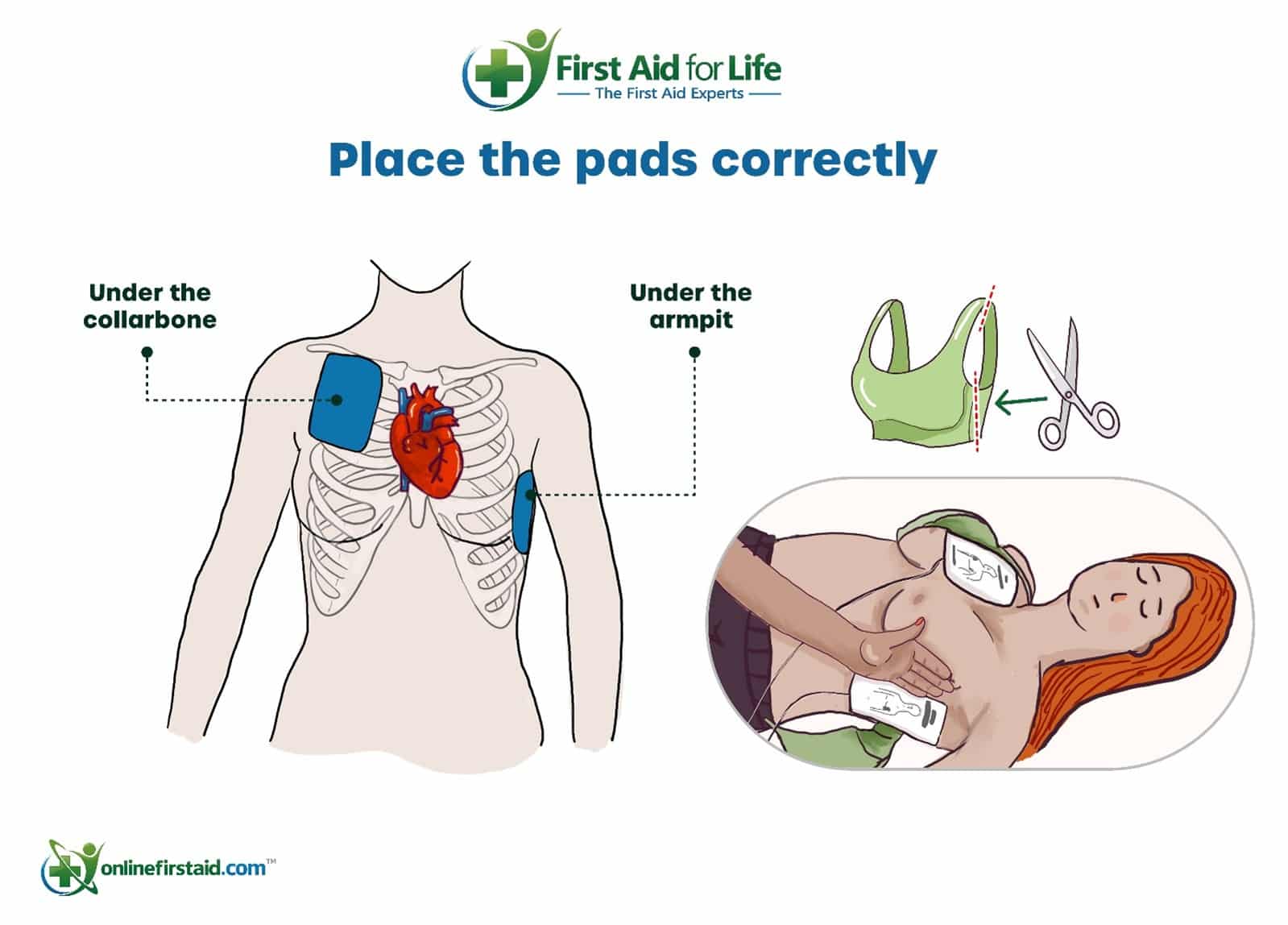
- One pad goes on the upper right side of the chest, just below the collarbone.
- The second pad should be placed on the left side of the chest, directly below the armpit, along the rib cage in what’s known as the mid-axillary line.
This placement is designed to direct the electrical current through the heart in the most efficient way. Both pads must be stuck firmly to bare skin.
You don’t need to remove jewellery, just don’t place the pads on top of it. If there is a medication patch where you need to position the pads, just remove it or stick it somewhere else on their skin.
Correct pad placement is more than just a technical detail, it’s a lifesaving one. The heart lies deep in the chest cavity, and if pads are placed too high, too low, or too close together, the current may not travel properly through the cardiac muscle. Resus Council UK in their 2025 update, emphasises the importance of good contact and accurate placement every time an AED is used.
If you put the pads on the patient’s chest and realise that you have put them on the wrong way round. Please don’t worry, they work equally well both ways. If you were to remove them and try and swap them, you would just lose some of the vital adhesion (stickiness) and make it harder for them to work
Using an AED on a woman
Women are 27% less likely to be resuscitated than a man. This is because they don’t tend to have accompanying chest pain when experiencing a heart attack and so may not recognise it and seek help in a life threatening situation. It is also due to a reticence from some people in starting CPR and using an AED. This is partly due to a perceived safeguarding issue and not knowing how and when to expose their chest to give CPR and use an AED. CPR can be undertaken with clothes on.
However, when using an AED, it is essential that the pads are placed on their bare chest. If the person is wearing a bra, it is usually easiest to remove it, ideally using the tough cut scissors kept with the AED. If this isn’t possible, the bra can be left on (even if it is underwired), and pads can be positioned under strap and side of the bra. In reality, AED pads are extremely sticky and it is not easy sliding them under the bra, it is usually much quicker to remove the bra altogether. However, it does depend on the type of underwear and clothing they are wearing and whether or not you have scissors to hand.
The 2025 RCUK guidelines reiterate that rescuers should prioritise effective pad contact and correct positioning over modesty concerns. In a real cardiac emergency, saving the person’s life takes priority. If you’re in a public setting, it’s best to use a jacket, towel, or blanket to preserve dignity after pads have been placed and resuscitation has begun.
How Do You Use a Defibrillator?
Using an AED might sound intimidating, but these devices are designed to guide you through each step. They’re intended for use by anyone, whether you’re a first aid-trained employee, a teacher, or a passer-by. Once you switch the AED on, it gives clear, calm voice instructions that tell you exactly what to do.
Here’s what happens when you use one:
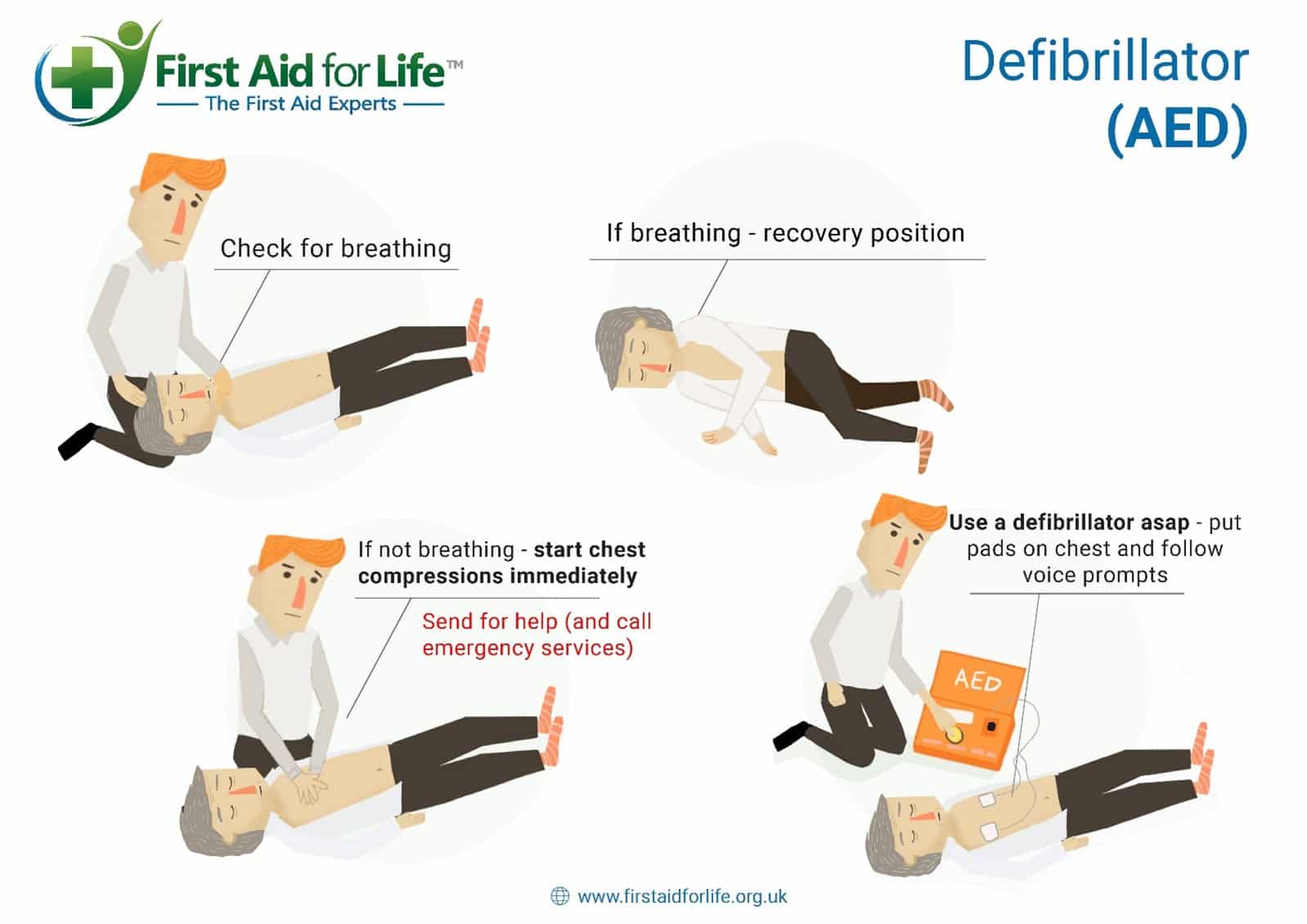
- Check for responsiveness and breathing. If someone is unresponsive and not breathing normally, ask for help, call 999 (or instruct someone else to), and ask someone to bring the defibrillator to the scene.
- If they are not breathing normally, have collapsed suddenly and are panting – Start CPR. If you are not sure, the call handler can help you check for normal breathing.
If they are unresponsive and breathing normally, carefully roll them into the Recovery Position and keep checking that they continue to breathe normally.
- To start CPR on an adult. Begin chest compressions immediately while someone retrieves the AED.
- To start CPR on a baby, child or adolescent – start with 5 rescue breaths before giving chest compressions.
- Turn on the defibrillator. Most devices have a single “On” button or will power on automatically when you open the lid.
- Expose the chest. Quickly remove or cut away clothing so that the chest is bare. This includes underwear and bras. The pads need to be positioned on the patient’s bare chest. Trying to slide the extremely sticky pads under the bra is not easy, it is much quicker and easier to cut the bra off if scissors are available.
- Attach the pads. Follow the pictures on the pads for correct placement, upper right chest and lower left side (or front and back on a child or baby)
- Allow the AED to analyse the heart rhythm. Do not touch the casualty during this time.
- Deliver the shock if advised. The AED will either shock automatically or tell you to press the shock button.
- Continue CPR. After the shock, resume chest compressions immediately and follow further AED prompts until emergency services arrive.
It’s that simple. AEDs are designed to do all the thinking for you — you just follow the instructions. They will not deliver a shock unless it’s needed, so there’s no risk of using one incorrectly and causing harm.
Do you need to shave someone when using an AED?
The pads should be placed on a clean, dry chest. Dry the chest with a towel, cloth or their clothing before putting the pads on. If the person has a large amount of chest hair, swiftly remove it with the razor. Only shave where you need to position the pads and if there are only a few hairs, don’t worry about removing them. The aim is to allow the pads to stick firmly to the chest to optimise their contact.
Can You Use a Defibrillator if Someone Has a Pacemaker?
Yes, you can, and you should. A pacemaker is designed to help regulate the heart’s rhythm, but during a cardiac arrest. It may not be functioning correctly or may not be enough to restart the heart. If someone has an implantable defibrillator (ICD) that should shock them automatically, however if it doesn’t you may need to use the AED, exactly as you would if they didn’t have an implantable defibrillator.
The presence of a pacemaker shouldn’t stop you from using an AED. However, pad placement may need to be adjusted slightly. The pads should not be placed directly over or too close to the device, as this can interfere with the electrical current. The RCUK’s 2025 guidance recommends placing the pads at least 8 centimetres away from the pacemaker site. In reality most pacemakers are positioned in the clavicle cavity on the left side and so shouldn’t be in the way of pad placement at all.
You can usually identify a pacemaker or ICD by a small, hard lump under the skin of the upper chest, often on the left side, just below the collarbone. If you see or feel this, move the pad slightly away. For example, place it a little lower or more towards the centre of the chest. You are still trying to place the pads as near as possible to the advised locations highlighted in this article, this will allow the best current path through the heart.
Can You Use a Defibrillator on a Child?
Yes, absolutely; AEDs can and should be used on children who are unresponsive and not breathing normally. Cardiac arrest in children is rare, but it can happen, and early use of an AED can be lifesaving.
The RCUK guidelines recommend that AEDs should be available in all public places, schools, and childcare settings. Many AEDs now have paediatric pads or a child mode that reduces the strength of the shock for younger patients.
If you need to use a defibrillator on a child, you’d place one pad on their front, to the left of their sternum, and you’d place the other in the centre of their back, between their shoulder blades. You are placing the pads in this way so they deliver the current through the heart. Follow the prompts and pictures on the pads to ensure the correct placement.
If a defibrillator doesn’t have child pads or a child setting, the Resuscitation Council UK says to use it anyway.
Some defibrillators have different pads for adults and children. You’d usually use child defibrillator pads for children up to the age of 8 years old. Adult pads are used for anyone over this age. Child defibrillator pads usually provide a smaller amount of energy than adult pads.
Some defibrillators use the same pads for both adults and children. In this case, these pads have pictures to show you where to put those pads on an adult and where to put them on a child up to 8 years old. If the same pads are used on adults and children, the defibrillator usually has a switch to choose either ‘adult’ or ‘child’. Selecting ‘child’ will usually reduce the energy level.
How much energy is delivered by a defibrillator?
Most modern defibrillators deliver a shock between 120 and 360 joules for an adult and 50-75 joules for a child. The defibrillator determines whether to deliver the adult amount or the child amount based on which pads are used or whether the user has selected the adult or child setting on the defibrillator, if your AED doesn’t have paediatric pads, you can still use adult pads; it’s far better to use them than to delay defibrillation. Just make sure the pads don’t touch each other. Use one pad on the front of the chest, one on the back.
For infants under 1 year old, use the defibrillator exactly as you would for a child. For babies, it is far less likely that they will be in a shockable rhythm. Paediatric CPR is of vital importance to them. However, if the AED indicates that a shock is advised, you should give the shock even if you only have adult pads or an AED with just an adult setting.
It’s important that schools, nurseries, and community organisations know whether their defibrillator has a child mode and where it’s located. In training sessions, staff should be shown how to switch between adult and child settings or where to find the paediatric pads.
The importance in giving the first shock ASAP
CPR alone rarely restarts the heart; its primary goal is to keep the heart and brain full of oxygenated blood and buy time for someone to bring an AED to help restore a viable rhythm. It is critical to minimise any delay to giving the first AED shock. If an AED is available use it ASAP. A study in Canada with 815 patients showed that if an AED can be used almost immediately, they are 52% more likely to survive. For every 5 seconds delay there is between a 13 and 18% reduction in survival rate.
To reduce this delay: Ensure everyone knows where the AED is kept and how to get it immediately.
- If you have a sick or unresponsive casualty get the AED there in advance (before they have gone into cardiac arrest).
- Ask a bystander to do CPR whilst you (or the first aider) put the pads on swiftly
- Check everything is clear and safe whilst the AED is charging
- Press the button immediately (in semi-automatic AEDs).
How the 2025 Update Helps Workplaces and Schools
The Resuscitation Council UK’s 2025 update encourages all organisations to review their first aid and AED procedures. For schools, nurseries, sports clubs and workplaces, this means ensuring that staff know:
- How to locate and use the AED.
- That pads must always go on bare skin.
- That it’s safe to use an AED on someone with a pacemaker or on a child. As long as placement is adjusted correctly.
It’s also a good opportunity to check that your AED equipment works, batteries with sufficient charge, appropriate pads that are in date, and clear, visible signage. Training sessions and refresher courses should include the updated 2025 recommendations so everyone feels confident in using the equipment correctly.
AEDs (alongside quality CPR) save lives, but only when they are used quickly and effectively. Encouraging staff and community members to practise pad placement during training helps remove hesitation in a real emergency.
About us
Written by Emma Hammett for First Aid for Life
It is strongly advised that you attend a Practical First Aid course to understand what to do in a medical emergency. Please visit firstaidforlife.org.uk and onlinefirstaid.com for more information about our practical and online courses and to access free resources.
First Aid for life provides this information for guidance and it is not in any way a substitute for medical advice. First Aid for Life is not responsible or liable for any diagnosis made, or actions taken based on this information.



0 Comments