
Pacemakers, Implantable Defibrillators and AEDs: Understanding the Differences and What to Do in an Emergency

Pacemakers, implantable cardioverter defibrillators (ICDs) and automated external defibrillators (AEDs) all play an important role in preventing sudden cardiac death and treating heart rhythm problems. Although they all involve electricity and the heart, they are designed for very different purposes.
Understanding how these devices work, why people need them and what to do if someone collapses can help save lives.
What is a pacemaker?
A pacemaker is a small electronic device implanted under the skin, usually below the collarbone. Thin wires connect the device to the heart. The pacemaker monitors the heart’s rhythm and sends tiny electrical impulses when needed to keep the heart beating regularly.
Pacemakers are generally used when the heart beats too slowly (bradycardia) or when electrical signals are not travelling properly through the heart due to heart block.The first fully implantable pace maker was fitted in Sweden on 8 October 1958. Since then, pacemakers have become smaller, more reliable and can often be monitored remotely.
People may need a pacemaker because of:
• Heart block
• Sick sinus syndrome
• Congenital heart defects
• Certain heart surgeries
• Age-related deterioration of the heart’s electrical system
What is an implantable cardioverter defibrillator (ICD)?
An ICD is similar in appearance to a pacemaker but has a different role. It continuously monitors the heart rhythm and can deliver
treatment if it detects a dangerous heart rhythm that could cause cardiac arrest.
An ICD can:
• Monitor the heart rhythm continuously
• Deliver pacing if the heart is too slow (pacing moderates the heart rhythm)
• Deliver rapid pacing to interrupt dangerous fast rhythms
• Deliver a cardioversion shock (to change a rhythm)
• Deliver a defibrillation shock if life-threatening ventricular fibrillation occurs
The first successful human ICD implant was performed in 1980 and the technology has saved countless lives since.
Why do people need an ICD?
ICDs are used for people at high risk of sudden cardiac death, including those with:
• Previous cardiac arrest
• Ventricular tachycardia
• Ventricular fibrillation
• Cardiomyopathy
• Certain inherited heart conditions
• Severe heart failure
Studies have shown that ICDs significantly reduce mortality in high-risk patients.
Pacemaker vs ICD
A pacemaker prevents the heart from beating too slowly. An ICD protects against dangerous fast or chaotic heart rhythms that can lead to suddencardiac arrest. Many modern ICDs also contain pacemaker functions.
High-profile People with ICDs
Christian Eriksen
In June 2021, Danish footballer Christian Eriksen suffered a cardiac arrest during Denmark’s European Championship match against Finland. Thanks to immediate CPR and rapid defibrillation on the pitch, he survived.
Doctors later implanted an ICD to protect him from future life-threatening arrhythmias. Following rehabilitation and medical assessment, Eriksen returned to elite football, first with Brentford, then Manchester United and later continuing his professional career.
His survival highlighted the importance of rapid CPR, AED access and early defibrillation. In June 2026 Eriksen again collapsed on the pitch following a cardiac arrest, however, his ICD
delivered a shock and he was able to walk off the pitch.
Fabrice Muamba
Former Bolton Wanderers midfielder Fabrice Muamba suffered a cardiac arrest during an FA Cup match in 2012. He received immediate CPR and 15 shocks from the AED at the scene
and during the ambulance ride to the hospital (2 on the pitch, 1 in the tunnel, and 12 in the ambulance). 11 additional shocks were administered by specialists once he arrived at the hospital. It was
78 minutes before they were able to restore a normal cardiac rhythm. However, because of the quality CPR and shocks from the AED, he was able to make a full recovery.
An ICD was implanted following his recovery. Although he retired from professional football, he has become a strong advocate for CPR training and AED availability.
Daley Blind
Dutch international footballer Daley Blind received an ICD after being diagnosed with heart muscle inflammation and rhythm disturbances. He has continued playing at the highest level with the device in place.
Can you do CPR on someone with a pacemaker or ICD?
Absolutely.
If someone is unresponsive and not breathing normally, start CPR immediately regardless of whether they have a pacemaker or ICD.
Chest compressions should be performed in the centre of the chest as normal. The presence of an implanted device should never delay life-saving treatment. However, it is likely that the ICD will shock them immediately when they collapse. Therefore they will probably regain consciousness before you have had time to start CPR.
Can you use an AED on someone with an implanted device?
Yes.
The British Heart Foundation and Resuscitation Council UK both advise that AEDs can safely be used on people with pacemakers and ICDs.
The only modification is pad placement.
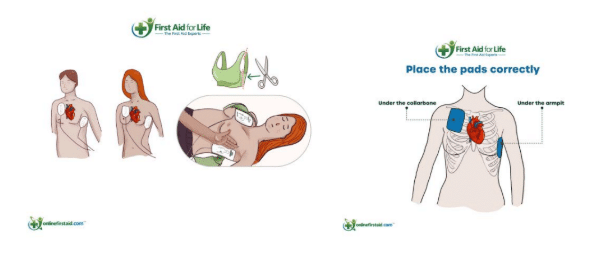
Where should you put the AED pads?
Look for a small lump beneath the skin, usually below the left collarbone.
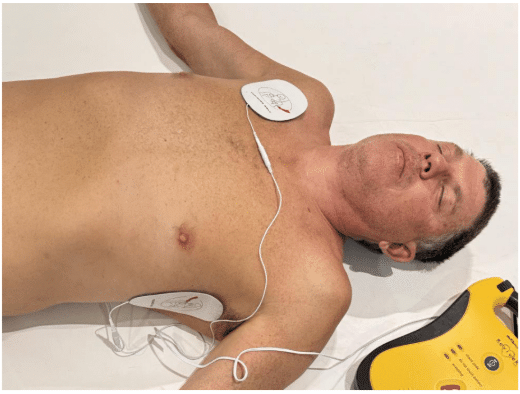
Consequently they implanted device should not interfere with pad placement as pads are usually placed below the right collarbone and below the left armpit.
Do not place an AED pad directly over the device.
Place the pad at least 8 cm away from the implanted device.
Standard placement remains:
• One pad below the right collarbone
• One pad on the left side of the chest below the armpit
What is an AED?
An Automated External Defibrillator (AED) is a portable device designed for public use.
Unlike an ICD, which is implanted inside the body, an AED is used externally during acardiac arrest.
AEDs:
• Analyse the heart rhythm
•Determine whether a shock is required
• Instruct rescuers with voice prompts
• Deliver a shock only when appropriate
Modern AEDs are extremely safe and designed to be used by members of the public with little or no training.
What should you do if someone collapses?
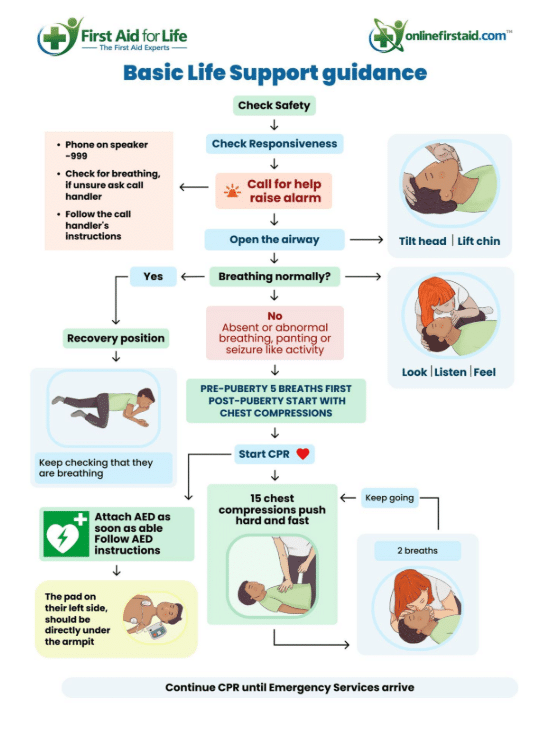
If someone suddenly collapses:
1. Check for danger.
2. Check for a response.
3. Open the airway.
4. Check breathing.
5. If they are not breathing normally, call 999.
6. Put the phone on speaker.
7. Start CPR immediately.
8. Send someone
to get an AED.
9. Follow the AED instructions.
10. Continue CPR until help arrives.
For adults:
• Compress the chest 5-6 cm deep.
• Push at a rate of 100-120 compressions per minute.
• Do not lean on the chest, the heart must be able to fully
recoil (fill with blood again)
• Minimise interruptions
Why are AEDs so important?
For every minute that defibrillation is delayed, the chance of survival falls by approximately 7-10%.
When CPR is started immediately and an AED is used within the first few minutes, survival rates can increase dramatically. Up to 74%.
This is why public access defibrillation programmes have become a major part of emergency cardiac care worldwide.
Where can you find an AED?
AEDs are increasingly available in:
• Schools
• Sports centres
•Transport hubs, bus depots and stations
• Airports
• Shopping centres
• Workplaces
• Community halls
• Village halls
• GP and dental surgeries
• Pharmacies
Many are registered on The Circuit, the UK’s national defibrillator network or on the Good Sam App. If you call 999, the ambulance service can direct you to the nearest registered AED.
Further reading:
Useful articles from First Aid for Life and Online First Aid include:
• How to Perform CPR and Use an AED
• All About Defibrillators (AEDs) – What They Are and How to Use Them
• Defibrillators Save Lives
• Recovery Position Guidance
Conclusion
Pacemakers, ICDs and AEDs all save lives, but they serve different purposes. Pacemakers help hearts beat regularly. ICDs protect people particularly at risk from life-threatening arrhythmias and can deliver internal shocks when needed. AEDs are external emergency devices that are widely available and can be used by anyone witnessing a cardiac arrest. If someone collapses, do not be afraid to act. Start CPR, call 999, use an AED if available and remember that having a pacemaker or ICD should never delay emergency treatment.
About Us
Award-winning first aid training tailored to your needs
It is strongly advised that you attend a fully regulated Practical or Online First Aid course to understand what to do in a medical emergency. Please visit https://firstaidforlife.org.uk or call 0208 675 4036 for more information about our courses.
First Aid for Life is a multi-award-winning, fully regulated first aid training provider. Our trainers are highly experienced medical, health and emergency services professionals who will tailor the training to your needs. Courses for groups or individuals at our venue or yours.
First Aid for life provides this information for guidance and it is not in any way a substitute for medical advice. First Aid for Life is not responsible or liable for any diagnosis made, or actions taken based on this information.


0 Comments