

DRABCDE Primary Assessment
The DRABCDE approach gives you a calm, structured way to check for and treat life threatening problems in order of priority. It is used by first aiders and healthcare professionals alike.
DRABCDE stands for Danger, Response, Airway, Breathing, Circulation, Disability and Exposure. You work through each step in order, only moving on when you have checked for – and, as far as you can, treated – any life threatening issues. Call for emergency help early and go back to the beginning of the assessment whenever the person’s condition changes.
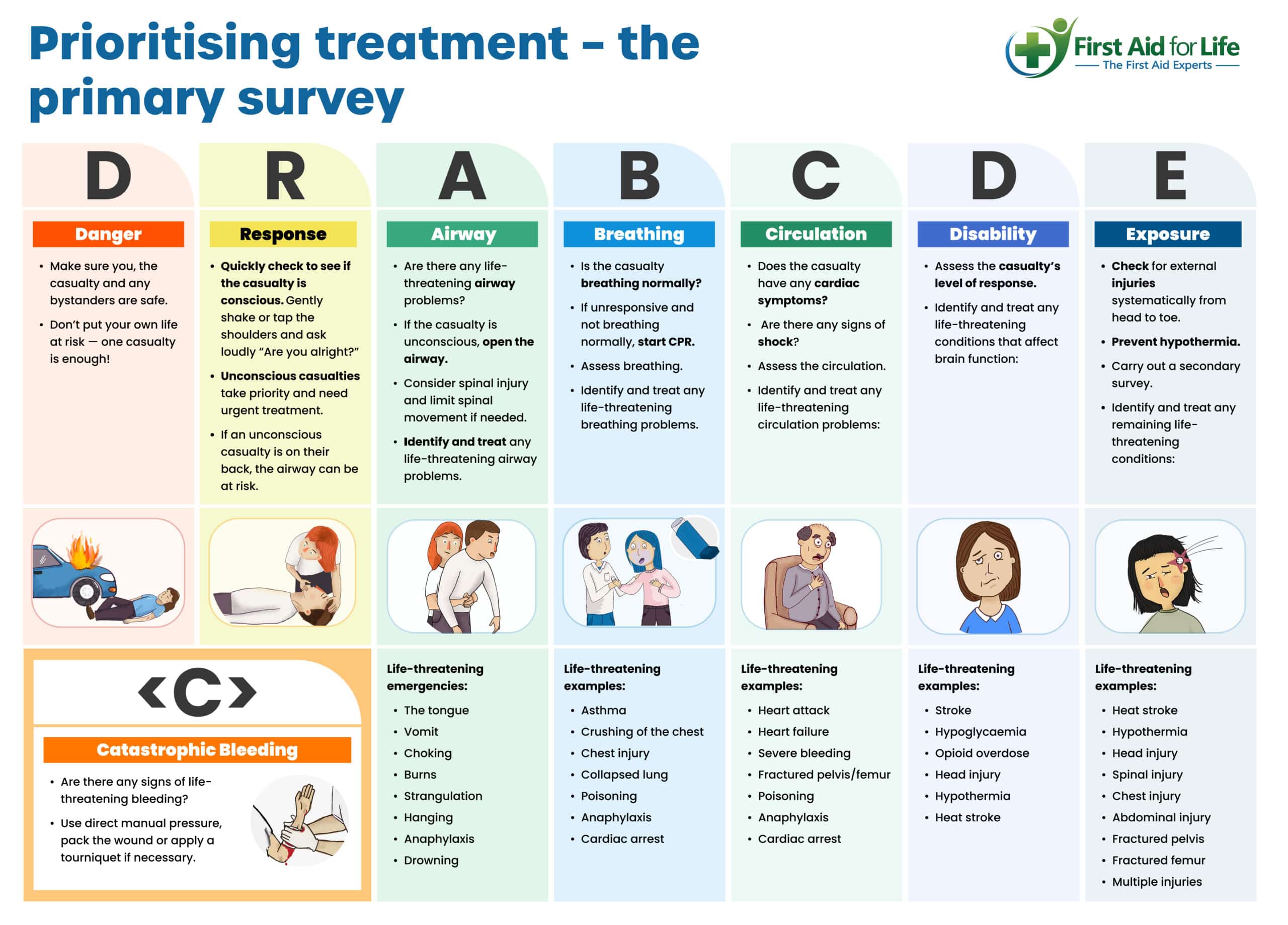
DRABCDE for the public and workplace first aiders
Follow the DRABCDE steps when:
- Someone has collapsed or looks seriously unwell.
- You are worried they may be unconscious, not breathing normally or bleeding heavily.
- You need a quick, safe way to decide what to do first.
D – Danger
If you are first on scene at a medical emergency, before you rush in to help, take a deep breath, clear your head and calm yourself. Then quickly check for any danger to you, the casualty or bystanders. Look for traffic, fire, electricity, sharp objects, unstable structures, aggressive behaviour or anything else that could harm you. Do not put yourself at risk. If the scene is unsafe, stay back and call 999 or 112.
If it is safe, put on gloves if they are available and only then go to the casualty.
R – Response
As you approach, talk to the casualty so you do not startle them. Kneel by their chest and ask loudly: “Are you OK?”, “Can you open your eyes?”, “Can you hear me?”. If it is safe to do so, gently shake their shoulders.
- If they speak, move or open their eyes, they are responsive.
- If they do not respond at all, treat them as unresponsive and move on swiftly.
At the same time, do a fast visual check for catastrophic bleeding – large amounts of blood pouring, gushing or spurting from a wound. If you see this, deal with it straight away before moving on to the airway. Press firmly on the wound with a clean pad, dressing or cloth and call 999 or 112.
Put your phone on speaker mode and the call handler will help you establish if they are breathing normally.
A – Airway
An open airway is essential for life. If the person is unresponsive, they may not be able to keep their airway open.
- Lay them on their back if you can do so safely.
- Place one hand on their forehead and gently tilt the head back.
- Use two fingers under the bony part of their chin to lift it up (the head tilt, chin lift manoeuvre). Alternatively, if you are concerned they might have a spinal injury, and you have been trained to do so – open their airway using a jaw thrust manoeuvre. If you haven’t been trained to do this, just do the tilt head and lift chin.
Look into the mouth. If you can clearly see something obvious and easy to remove, such as loose dentures or a large visible object, carefully remove it. Do not put your fingers blindly into the mouth or attempt a difficult extraction as this may push the object further down or injure you.
B – Breathing
Keeping the airway open, check if they are breathing normally. This check should take no more than 10 seconds
- LOOK for the rise and fall of the chest.
- LISTEN for sounds of normal breathing at their mouth and nose.
- FEEL for their breath on your cheek.
Occasional gasps, snorting or infrequent noisy breaths after a collapse are not normal breathing and can be a sign of cardiac arrest. If you are unsure, treat them as not breathing normally. The 999 call handler can help you to establish if the casualty is breathing normally.
If they are unresponsive and not breathing normally:
- Start CPR following current guidance. 30 compressions and 2 breaths for an adult.
- 5 breaths first, 15 compressions to 2 breaths if you are paediatric first aid trained.
- Administer the AED as quickly as you can.
- If the call handler is talking you through CPR, let them know if you have been first aid trained, as otherwise they will just talk you through compression only CPR. Breaths are still the gold standard for CPR and give the casualty an even better chance.
- If the casualty is breathing normally, go on to check their circulation and any severe bleeding.
C – Circulation and bleeding
Once you know they are breathing, quickly check for signs of severe external bleeding. Look under and around them for a pool of blood and scan their body for obvious wounds.
If there is heavy bleeding:
- Apply firm, direct pressure over the wound with a clean pad, dressing or cloth.
- If blood soaks through, add more dressings on top – do not remove the original one.
- Keep pressing hard until help arrives.
- Call 999 or 112 for emergency help.
If they are unresponsive, breathing normally and there is no severe bleeding, place them in the recovery position if you know how to do so safely. This helps to keep the airway clear and allows fluid or vomit to drain from the mouth. Continue to check their breathing regularly until emergency help arrives.
D – Disability (level of response)
“Disability” in DRABCDE is a quick check of how well the brain is working. You are looking for any change in their level of response.
A simple scale you can use is AVPU:
- A – Alert: they are awake, talking and know what is going on.
- V – Voice: they respond only when you talk to them.
- P – Pain: they only respond to a painful stimulus, such as gently squeezing their shoulder.
- U – Unresponsive: they do not respond at all.
If you are a trained workplace first aider and have the correct kit, you may also be able to check their blood sugar level using a finger prick test. Follow your training and your workplace policy carefully.
E – Exposure and examine
Finally, have a careful look over the rest of the body to find any other injuries or clues as to what has happened. You may need to loosen or remove some clothing to do this properly.
- Expose only as much as you need to examine the person.
- Protect their dignity and keep them as warm and covered as possible.
- Look for rashes, swelling, deformity, burns, medical alert jewellery, medication packets or inhalers nearby.
- Note anything that might help the paramedics or doctors understand what has happened.
Once you have completed DRABCDE and dealt with any immediate dangers, keep monitoring the person. If their condition changes, go back to the beginning of the DRABCDE assessment and work through it again.
About us
Written by Emma Hammett for First Aid for Life
First Aid for Life is a multi-award-winning, fully regulated first aid training provider. Our trainers are highly experienced medical, health and emergency services professionals. They will tailor the training to your needs. Courses for groups or individuals at our venue or yours. Please visit our site and learn more about our practical and online courses. It is vital to keep your skills current and refreshed.
We strongly advise that you attend a fully regulated Practical or Online First Aid course to understand what to do in a medical emergency. In addition, please visit First Aid for Life or call 0208 675 4036 for more information about our courses.
First Aid for life provides this information for guidance and it is not in any way a substitute for medical advice. First Aid for Life is not responsible or liable for any diagnosis made, or actions taken based on this information.


0 Comments