
First Aid For Choking Adults, Children & Babies

A topic we always cover on our first aid courses is how to help someone of any age who is choking. It is one of the most common emergencies people witness – and one of the most time-critical.
The problem isn’t simply that people don’t know what to do; many don’t realise how fast a choking incident can turn serious. Research found that 32% didn’t realise choking can become life-threatening within minutes, and 19% had never even heard of an abdominal thrust.
That combination – not recognising the urgency and not knowing the techniques – wastes the very minutes that matter most. The reassuring news is that the steps are simple to learn and quick to remember. Here is exactly what to do if an adult, child or baby is choking.
What to do when a child is choking
- Babies and young children can choke on anything that can fit through a loo roll. To prevent choking: keep such small objects out of reach, cut up food into very small pieces and supervise children while they’re eating, especially if they’re under five years old.
- If a child shows signs of choking, stay calm and ask them to cough as doing this can often release whatever is stuck themselves. If this doesn’t work then follow the steps below to clear a blockage.
When someone is choking: Unable to speak or cry, clutching their throat, struggling to breath
For the purpose of first aid, a child is aged from 1 year to puberty.
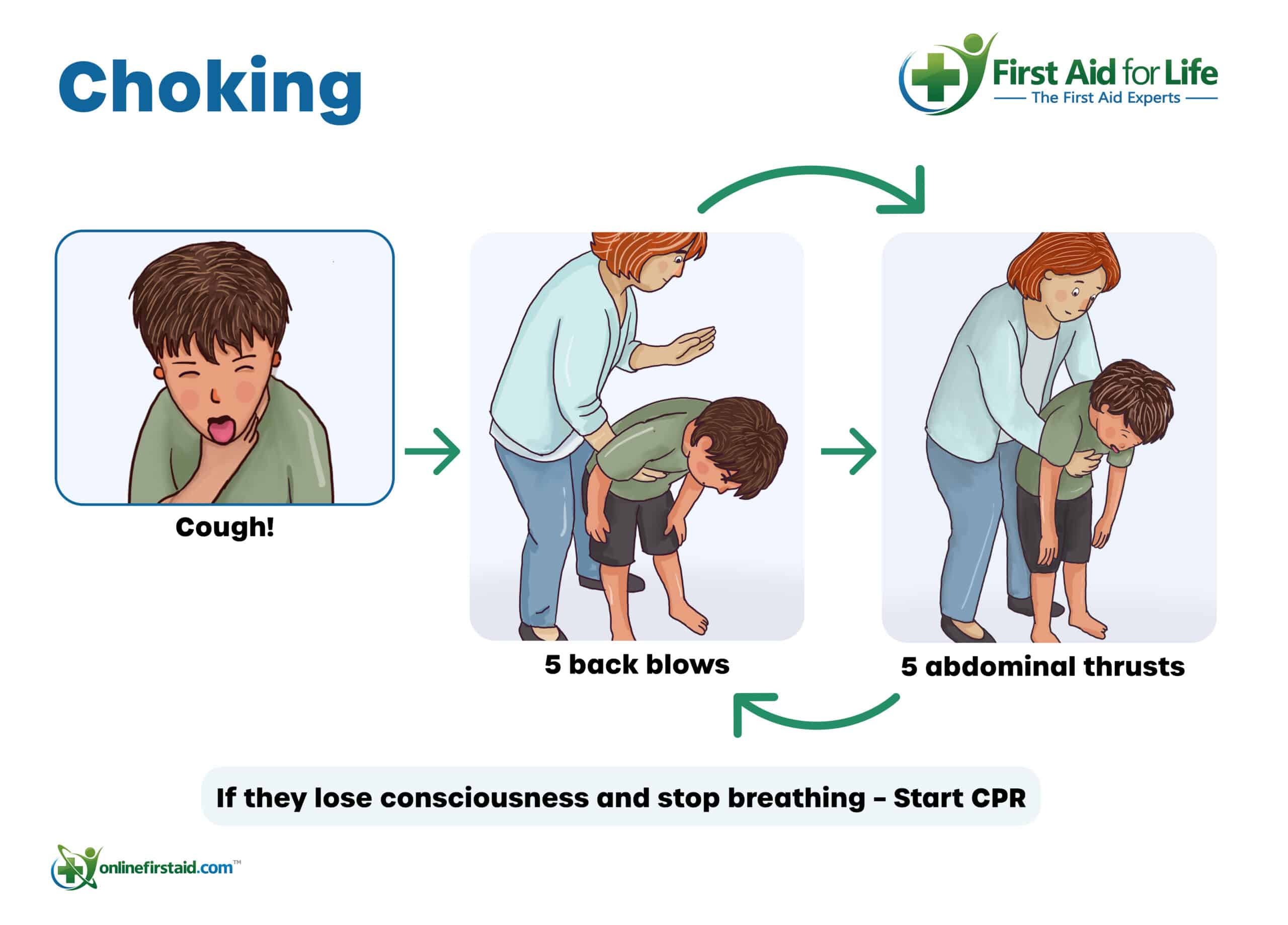
Bend the child forward, with one hand supporting them on their chest
· with the other hand and use the flat of your hand to give a firm back blow between the shoulder blades.
· Check to see if the blockage has cleared before giving another blow.
If the back blows haven’t helped, get an ambulance on the way
If they are still unable to breathe after five back blows, begin abdominal thrusts:
- Stand behind the child and place one hand in a fist between their tummy button and their rib cage. Use the other hand to pull up and under in a J shaped motion, to dislodge the obstruction. Perform abdominal thrusts up to 5 times, checking each time to see if the obstruction has cleared.
Anyone who has received abdominal thrusts must be seen by a doctor.
If the child is still choking, call 999 (or 112). Alternate five back blows and five abdominal thrusts until emergency help arrives. If at any point the child becomes unconscious, commence CPR.
How to help a choking baby
- First look in the baby’s mouth and if there is something obvious in the mouth, remove it with your fingertips.
DO NOT put your fingers down a baby or child’s throat, or finger sweep the mouth, as this can make matters worse by pushing the obstruction further down or by causing swelling.
When babies are weaning and learning to eat solid foods, it is common for them to gag. In gagging, they are exploring new textures and expelling their food from their throat. Gagging is an effective way that the body avoids choking and although it is noisy and alarming, it is to be encouraged. To learn more about the difference between gagging and choking click here.
A baby that is choking, with a complete obstruction of their airway, will be silent.

- Lay the baby downwards on your forearm or across your legs, supporting them under their chin and using the flat of your hand. Give a firm back blow between the shoulder blades.
- Give up to five back blows and check between each blow to see if the blockage has cleared. If the obstruction has not come out then I would get an ambulance on the way
- If the blockage hasn’t cleared, lay the baby on their back, place two thumbs in the centre of the chest just below the nipple line and give up to five chest thrusts.
Warning: Never do abdominal thrusts on a baby under a year as you could cause damage.
· Check to see if the blockage has cleared between each chest thrust.
· If baby is still choking, call 999/112 and continue alternate five back blows and five chest thrusts until emergency help arrives.
How to help a choking adult:
- Always check first to see if someone is able to cough and encourage them to do so as often they are able to clear the blockage themselves.
If they are unable to cough:
· Bend them forward supporting them on their chest with the other hand and use the flat of your hand to give a sharp back blow between the shoulder blades. Check to see if the blockage has cleared before giving another blow. If the blockage hasn’t cleared after five blows, begin abdominal thrusts:
Get an ambulance on the way if the back blows haven’t worked
- Stand behind them and place one hand in a fist under their rib cage. Use the other hand to pull up and under to dislodge the obstruction. You are using a J-shaped motion to pull up and under their rib cage. Perform abdominal thrusts up to 5 times, checking each time to see if the obstruction has cleared. Anyone who has received abdominal thrusts must be seen by a doctor.
· If the person is still choking, call 999 (or 112) and alternate five back blows and five abdominal thrusts until emergency help arrives. If at any point they become unconscious, commence CPR.
When the obstruction comes out:
Put them into the recovery position if they are unconscious and breathing.
If they are unconscious and not breathing then you should start CPR.
If they seem absolutely fine – ensure that they don’t have problems swallowing, check there is no pain or bleeding – it is always advisable to have them checked out by a medical professional. You should make sure you have contacted the parents if this is not your child.
If someone has been given abdominal thrusts or chest thrusts, they should always be checked by a medical professional

Did you know that blind cords can be a potential risk for children? click here to discover more.
Written by Emma Hammett RGN Founder and CEO of First Aid for Life.
We cover First Aid for Choking on all our practical and online first aid courses. Please book in and learn these life-saving skills now.
First Aid for Life is the leading provider of first aid training for schools, parents, child carers and health workers and our team of highly experienced medical, health and emergency services professionals will tailor the training to your needs. We incorporate anaphylaxis training in all our first aid courses and can provide specialist annual refreshers as needed. We always train using all devices.
Attending a First Aid course is strongly recommended by us to understand what to do in a medical emergency. First Aid for Life run specific courses covering in detail how to help someone having an asthma attack.
Please visit www.firstaidforlife.org.uk, emma@firstaidforlife.org.uk or tel: 0208 675 4036 for more information about our courses. First Aid for Life provides this information for guidance and it is not in any way a substitute for medical advice. First Aid for Life is not responsible or liable for any diagnosis made, or actions taken based on this information.


Is it possible for a toy that passed the choke cylinder test to still impede a 2 year old child’s breathing if it was small enough for them to put in their mouth?
The incident involved a wooden food-like toy that passed the choke test but required back blows.
Thank you Ron. Unfortunately people choke on a huge variety of things and the choke cylinder test can only be used as a possible indicator.