
How to Help Someone with a Life Threatening Bleed
Knife crime is at a record high in the UK.
Every day the news reports yet another story of injury or fatality related to knife crime. Would you know how to help with major bleeding while also keeping yourself safe?
In the year ending March 2023, there were around 49,500 offences involving a knife or sharp instrument in England and Wales (excluding Greater Manchester Police Force). During this same period, in London, the total number of offences involving knife crime increased by 7%. According to police records, there were 49,489 incidents involving a knife or sharp instrument between January and December 2023, compared to 46,153 the previous year. MP Florence Eshalomi has warned that Londoners risk becoming ‘desensitised’ to knife crime. While speaking at the Commons, she recalled how scared she had felt after coming across a teenager bleeding from knife wounds in his legs. Eshalomi said she felt disappointed that many passers-by walked on while she ‘frantically’ alerted the emergency services.
Keep Yourself Safe
Always do your best to keep yourself and others safe. If you are caught in a terrorist attack or any mass casualty event, your actions can make a vital difference to your safety and to others around you. In stressful moments, remember the simple mantra: “Run, Hide, Tell.” There is official police guidance for what to do during a firearms or weapons attack. Citizen’s Aid has a really helpful App that I would encourage everyone to download.
Giving Initial First Aid in an Attack
If people around you are injured in a mass casualty incident, you might be able to save a life before professional medics arrive. However, do not attempt to give first aid until you are sure that you are not in immediate danger. In a terrorist attack scenario, this means you should have either escaped the attacker or found a safe hiding spot first. Once you are relatively safe, you can turn your attention to helping the wounded.
Only help others if:
(1) You are not injured yourself,
(2) You are in a safe position where you are not exposing yourself to the attacker, and
(3) You feel capable of assisting.
If these conditions aren’t met, focus on TELL (calling emergency services) and wait for trained responders. But if you can help, here are guidelines for treating life-threatening injuries in an emergency:
Prioritise casualties with life-threatening conditions. In a mass casualty event, some people may have minor injuries, and some may be critically hurt. You should focus your limited time on those who need immediate, life-saving aid.
Specifically, look for:
- Victims with massive bleeding (spurting blood, partially severed limbs, or bleeding that is rapidly pooling).
- Victims who are unresponsive and not breathing normally (or only making gasping breaths). They will need CPR.
- Victims who are unresponsive and breathing normally – who should be rolled into the recovery position.
Those categories are the highest priority for first aid. Someone who is conscious and “only” has a broken arm or minor cut can wait. Only help one casualty at a time – do what you can for the most critical, then move to the next.
First Aid Following a Stabbing
You should also remember that this is a crime scene. After calling the emergency services do try to preserve any evidence you can and don’t move anything other than what you need to do in order to administer life-saving first aid. Do wear gloves if possible.
Before approaching the victim and crime scene, always ensure that the area is safe and you are not in any danger yourself, before administering any first aid.
You must first examine the area to see if there is anything stuck in the wound. If so, do not remove it as it is likely to be stemming bleeding. Apply direct pressure either side of the object. Do note that most perpetrators do not leave the weapon in the victim.
If they are unconscious and breathing, put them into the recovery position and treat any obvious bleeding.
When they are unconscious and not breathing:
If there is a life-threatening bleed that you are unable to stop with direct pressure – then this is a catastrophic bleed. Therefore, this is a priority over resuscitation.
If there is no obvious pulsating bleed, and they are unconscious and not breathing – then call for an ambulance (and a defibrillator) and commence CPR immediately.
The Importance of First Aid
It is important to know how you can help if you end up in a situation where someone has been stabbed. In this way, you can react in an effective and calm manner.
Catastrophic bleeding is a common result of stab wounds but is not just confined to crime. It can happen any time and anywhere. It can occur as a result of DIY injuries, accidents in the kitchen or even after a slip of a saw whilst cutting branches in the garden. There are some very simple steps to follow that could help enormously and save lives. Read on to find out what to do for treating major bleeding and shock, should you be first on the scene at such an accident. This article will help you learn how to help someone who has been stabbed or seriously bleeding.

Bleeding
If someone is bleeding the priority is to stop the blood coming out! If possible, ALWAYS WEAR GLOVES WHEN DEALING WITH BLEEDING
It is never a priority to wash a major injury – it will be cleaned in thr hospital.
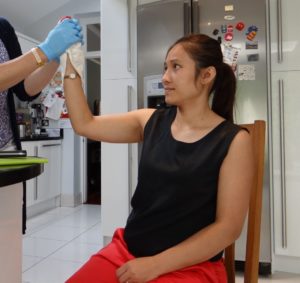
Use this mnemonic to help guide you.
Sit or lie the person down – to manage shock and prevent them from feeling dizzy and faint.
Examine the area to see if there is anything stuck in the wound – if there is do not remove it.
Elevate the bleeding area above the level of the heart to slow down the bleeding. Please note that the latest guidelines no longer recommend elevation. This alone will not stop bleeding and pressure is more important.
Pressure – apply direct pressure on the wound to stop the blood coming out.
Shock
Shock is ‘a lack of oxygen to the tissues of the body. The most likely cause is a fall in blood volume or blood pressure’.
It occurs as a result of the body’s circulatory system failing to work properly. That means the tissues of the body, including the heart and the brain, struggle to get sufficient oxygen. The body’s response to this is to shut down the circulation to the skin. Therefore, it becomes pale, cold and clammy. The heart speeds up as it struggles to get sufficient blood supply and oxygen and to draw the blood away from the gut. Thus, the casualty may feel sick and thirsty. They may also feel anxious, dizzy and a bit confused. This is because their brain suffers from the lack of oxygenated blood too.
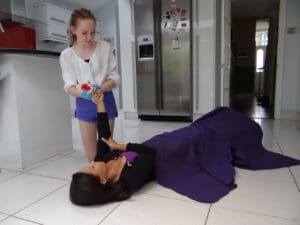
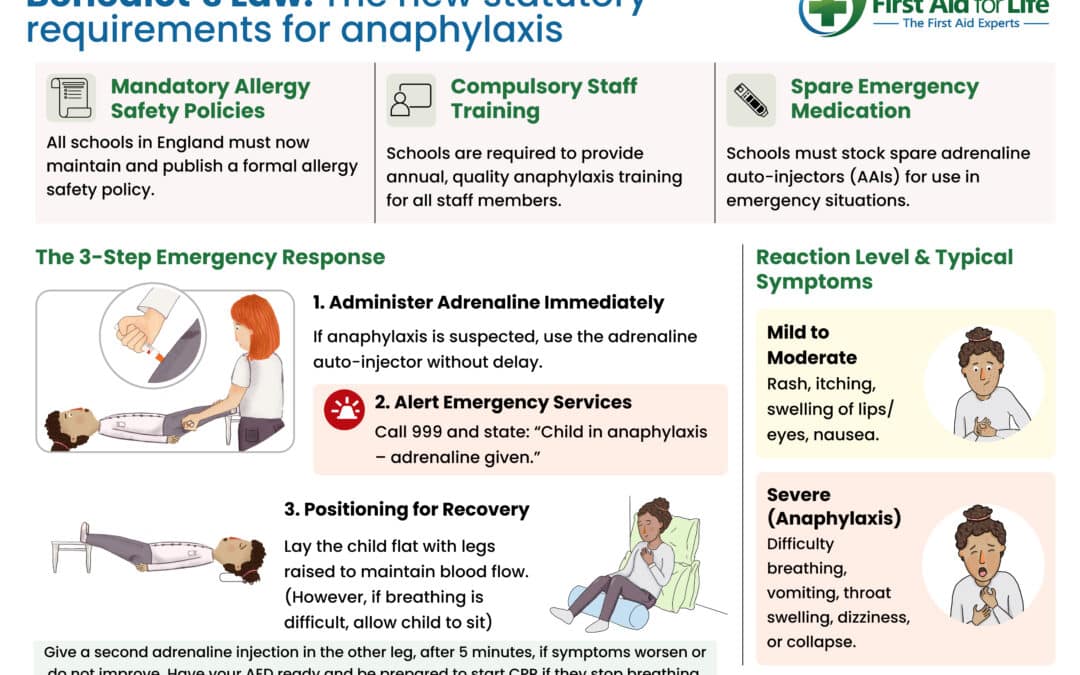
If the person is pale, cold, clammy and showing signs of shock, or if they have lost a lot of blood – help their circulation by lying them down and raising their legs. Elevate the bleeding wound and apply direct pressure to control the bleeding.
Keep them warm and get emergency help.
Symptoms of shock:
- A rapid pulse.
- Pale, cold and clammy.
- Grey-blue skin colour and blue tinge to the lips.
- Weak and dizzy.
- Nausea and vomiting.
- Thirst.
- Shallow, rapid breathing.
- May become restless and possibly aggressive – a sense of ’impending doom’.
- Yawning and gasping for air.
- Eventually they will lose consciousness and become unresponsive and they may stop breathing.
How much blood can you afford to lose?
Children have far less blood than adults.
A person has approximately 0.5 litres of blood per 7kgs of body weight or one pint of blood per stone (although this does not increase if someone is over weight). An ‘average’ adult has roughly 10 pints / 6 litres of blood. If they lose about a 5th of their blood volume it can cause the body to shut down and go into shock.
The loss of a tea cup full of blood could be fatal for a baby. However, please note that head and facial injuries bleed copiously and can look far more scary than they are. A tea cup full of blood would make a major mess!
If a casualty loses a substantial amount of blood – more than 40% of their blood volume, the body is no longer able to compensate for that amount of blood loss. Thus, casualties will develop hypovolaemic shock. Hypovolaemic shock is a low volume of blood causing failure of the circulatory system. If untreated, casualties will die.
If someone is bleeding extremely heavily from either a major artery or vein, they can lose a lot of blood very quickly. The bleeding is likely to pulsate in time with the heart. This is more pronounced with an arterial bleed, but can also happen with a venous bleed. With extremely heavy, potentially catastrophic bleeding an adult could easily lose 40% of their blood volume in 3-4 minutes. This could be even quicker when dealing with children.
The treatment of all bleeding remains the same:
- Encourage the casualty to sit or lay down in the most appropriate position for the location of the wound and the amount of blood lost – if they are feeling dizzy and showing early signs of shock, raise their legs.
- Examine the wound to rapidly assess:
- The type and extent of bleeding
- The source of the bleeding
- Whether there are any foreign objects embedded in the wound. If so, do not remove them as they will be stemming bleeding. Apply direct pressure either side of the object.
- Apply direct pressure to try and control bleeding. If the bleeding is controlled with this direct pressure, keep holding for 10 minutes as it takes this amount of time for clots to form.
- Once bleeding is controlled, dress the wound. If the wound bleeds through the first dressing, apply another on top. If the wound bleeds through the second dressing you should consider alternative options to stop the bleeding.
Catastrophic bleeding
A Catastrophic bleed is when the bleeding is so severe that it is not possible to stop it with direct pressure. It usually occurs due to a damaged artery and someone can bleed to death in a matter of minutes. When dealing with a catastrophic bleed, stopping the bleeding takes priority over everything else – including CPR.
The first step when treating a catastrophic bleed is always to apply direct pressure. It is still likely to be the first and only solution needed for the casualty.
In environments where a catastrophic bleed is likely; tourniquets and haemostatic dressings should be an integral part of the first aid kit. All First Aiders should be trained in their use.
Packing a wound: If the bleed is in the trunk of their body, or the wound is very deep and open; you may need to locate the source of the bleeding by placing your finger or hand into the bleeding cavity. Once you have identified the source of bleeding, the cavity needs to be packed with an improvised or ideally a commercial sterile haemostatic dressing.
For the general public; you are highly unlikely to need to use a tourniquet. However, understanding how to improvise and how and when to use one, could save lives if you were involved in a major medical accident or emergency.
How to make an improvised tourniquet
One of the easiest ways to make an improvised tourniquet using the contents of a standard First Aid kit is to use a triangular bandage folded into a broad fold bandage and tighten the tourniquet using your scissors as a windlass. If you have access to cutlery, such as a table knife, this would be even better. Otherwise you no longer have your scissors available to use!
Please note: A tourniquet should be at least 4cm wide to prevent localised damage to nerves tissues.
- Tie the bandage as quickly and tightly as possible around the bare limb.
- The tourniquet should be 5-7cm above the wound. Never place a tourniquet over a joint.
- Tighten the tourniquet until the life-threatening bleeding stops. This will be extremely painful to the casualty, explain to the casualty that this is vital to save their life.
- If the bleeding will not stop; try tightening the tourniquet further or apply a second above the first one. Slight bleeding may still continue, but the life-threatening bleeding should be controlled.
- Ensure someone has called 999/112 for help.
- Note the exact time of the application and write this prominently on the tourniquet if possible.
- NEVER release the tourniquet yourself. This should only be done by a healthcare professional in a controlled environment.
If there’s a clean cut through an artery, for example in a deep incised wound, it is possible that the artery can contract back up the arm or leg. This is why you should place the tourniquet at least 5cm (or 2 inches) above the wound.
Other guidance

Place the knife or your scissors on top of the knot and tie another knot on top of them.

Use the knife or your scissors as a windlass to wind round and tighten the tourniquet.
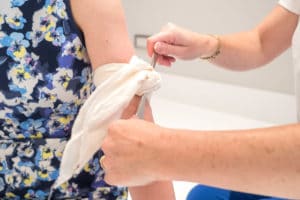
You can secure the windlass either by tying another triangular bandage to stop it unwinding or by wrapping and tying both ends of the triangular bandage around the ends of the windlass to ensure it remains in place.
It is important to note the exact time in which you applied the tourniquet. Furthermore, you must arrange for an urgent transfer for medical help. Ensure you tell them where and when you applied the tourniquet.
Please note: it will be extremely painful for the casualty to have a tourniquet, but it is absolutely vital that you apply a tourniquet tight enough to entirely stop the bleeding.
If a tourniquet is not tight enough it can make things worse. It can occlude the veins, but arteries may be harder to stop as they are less easy to get to. If the venous return is stopped by the tourniquet, the only place for blood to come out is from the wound.
NEVER be tempted to loosen or remove a tourniquet. Once you have applied it, ONLY a doctor in a hospital setting should remove the tourniquet
Follow the Government’s instructions advising what to do: https://act.campaign.gov.uk/ and download a handy app: https://www.citizenaid.org/
There are many initiatives operating around the country to try and curb the increase in knife crime and the numbers of our young people being injured and killed in this way. One proven initiative aimed at both preventing weapon carrying and increasing the chance of survival following an attack, is to teach these young people first aid.
First Aid for Life can help
We are a multi-award-winning, fully regulated first aid training business with experience working with schools, Young Offender Institutes, PRUs, voluntary organisations, charities and Youth clubs nationwide, to teach young people the vital skills they need to save a life, should the worst case scenario arrive.
Our ebook on first aid for stabbings is a useful resource to educate and inform young people and youth organisations on the dangers of street crime. Moreover, it is a helpful guide to ensure people know what to do if they encounter a stabbing victim.
First Aid for Life specialises in empowering young people with the skills and confidence to keep themselves and others that bit safer. We teach them that carrying a weapon makes you more at risk. The risks of carrying weapons such as knives, guns and acid and the damage this can do, are clearly explained. We equip young people with the skills and confidence to help each other in a first aid emergency, giving them both general first aid training as well as specialised first aid training encountered in a street crime context.
We run courses for young people and youth workers across the country, who welcome the opportunity to learn how to treat serious and catastrophic bleeds with improvised and manufactured tourniquets and packing. Training can be entirely adapted to your needs and budget. We can blend practical and online modules.
Our trainers are highly experienced medical, health, military medics and emergency services professionals, who will tailor any training to your needs and the needs of the children and young people you are working with. Our trainers are all DBS cleared and superb at teaching engaging practical courses to children, young people and adults.

About us
First Aid for Life provide award-winning first aid training tailored to your needs. Please visit our site and learn more about our practical and online courses. It is vital to keep your skills current and refreshed. We are currently providing essential training for individuals and groups across the UK. In addition, we have a great range of online courses. These are ideal as refreshers for regulated qualifications or as Appointed Person qualifications.
You can attend a fully regulated Practical or Online First Aid course to understand what to do in a medical emergency. Please visit https://firstaidforlife.org.uk or call 0208 675 4036 for more information about our courses.
First Aid for Life is a multi-award-winning, fully regulated first aid training provider. Our trainers are highly experienced medical, health and emergency services professionals who will tailor the training to your needs. Courses for groups or individuals at our venue or yours.
First Aid for life provides this information for guidance and it is not in any way a substitute for medical advice. We are not responsible or liable for any diagnosis made, or actions taken on this information.


I would like to know is it important to have an ultrasound after having a radial artery bleed out in the forearm from a shard of glass?
Or do you just go straight to surgery to repair damaged artery?
Thankyou
Dear Maryanne,
The most important thing is that you are seen at a hospital and they will advise appropriately. Hope that helps.
Best wishes
When a person has a main artery in the throat cut is pressure still the best way to stop the bleeding?
I am afraid if they have had their main artery to their throat cut, then the prognosis is not good.
if the person starts bleeding between the brain and the skull and it causes a seizure what’s the best way to help?
If they have a bleed between the brain and the skull, this will put pressure on the brain and compress it. This is extremely serious and will need immediate paramedic and hospital attention to release the pressure on the brain to ensure permanent brain damage does not occur.
Haha no shit she asked you what she should do not what the prognosis is. Haha anyways yes applying pressure putting your thumb or stuffing the whole with gauze that is of course if standard practice will leave you with a “poor prognosis’
Should you cauterize an artery to stop mass blood lost, I know this can cause more damage and isn’t too great bacteria wise but would it not be a quicker solution for a serious cut??
That should only be done in hospital
What happens if the stab occurs in the neck region? How can you help stabilize the victim? Can you use a tourniquet or bandage for that?
You would just need to apply pressure. You would never apply a tourniquet to someone’s neck as you would cut off the blood supply to their brain. Only use tourniquets on limbs.
So someone very close to me died from being stabbed in the heart and in the chest.he collapes and past out someone was there trying to do cpr and hold his wounds at the same time.what could she have done differently.
So sorry to hear about your experience. Unfortunately we can’t save everyone and it sounds like they did their very best
My bf got stabbed about an inch into his shoulder and it is bleeding profusely and I don’t know what to do
Tq for sharing ur knowledge…
How would one treat and control a wound to the cavity? With no object in wound? Asking from a remote location.
Should a person be stabbed in the back by a terrorist, and the blade is stuck in the back while the handle is sticking out. Mild bleeding, should one remove the blade to put the victim on his back until the ambulance comes and prevent shock, or leave it in?
TIA
Never remove an embedded object from a wound. It is likely to be stemming bleeding, you could also cause further damage when removing it.
Author here! I’m writing a fight scene, and wondering about the realistic results of a wound. If someone was stabbed in the stomach (general stomach area) with a long knife, what are the chances that they could survive? I’ve heard some people say that stomach wounds are fatal. What should someone do to treat that wound? Would there be any long-term repercussions of a wound like that?
Hello, hope I can help.
Prognosis is not good but it may be possible to survive. A “long knife” will most likely penetrate your characters organs, but if the knife misses the big blood-filled organs, such as the spleen/liver then theres a good chance that they will survive more than a few minutes. There is no such thing as “it missed everything” but some areas are better than others. i suggest you have a quick glance at where the major arteries/blood vessels are on a anatomy chart and avoid them.
Next would be shock/blood loss. If the knife is still in then thats good, otherwise they will need immediate attention to survive. A stab to the abdomen would most likely cause them to collapse and a severed abdominal muscle may mean that they will not be able to walk away on their own. If there is a companion/responder present to apply pressure and get them safety then they may survive.
Next is the consequences. They will probably have internal bleeding which almost always requires surgery to stop. If their stomach/intestines were punctured by the blade then they will probably get peritonitis (A severe infection) which is survivable with antibiotics but is still a dangerous killer. Next is just regular infection from the wound itself.
So in summary – A stab wound is survivable but prompt action is necessary and will depend on the setting of your book. (However some people just get lucky so dont worry toooo much about it, i know cases of real people who have survived some insane stuff)
And the order of things most likely to kill them would be…Blood loss(Die within minutes if uncontrolled, or within an hour if not so serious but untreated) Shock (~5-20 min after incident if untreated) Internal bleeding (May be immediately present or show up later, same as other blood loss) Peritonitis (12-24 hours after incident) Regular infection (1-7days after incident (normally by day 2/3)) Then they may suffer from a burst hematoma or intestinal blockage (weeks to months after incident) but they might just get lucky and not suffer that
Another writer here: That’s the most perfect explanation! Thank you so much for the details – I’ve been searching for them for ages. I always get annoyed when a book doesn’t realistically portray wounds and I’m so glad I found your comment!
What Would you do if you see a person who is about to be stabbed by a robber?
I’m not an expert, but if you personally are a SAFE distance away from the fight then i would try screaming or shouting which may cause the mugger to panic or flee. Shout for help specifically or try to attract the attention of anyone in the area to what’s happening. e.g. “Look out that man has a knife! He’s attacking someone!”
If you are close to the robber/victim or are alone then do. not. engage! Get away safely if you can. If the attacker then attacks you for interfering then you and the victim may both die. You are way more likely to be of use to the victim if you can provide them with immediate medical attention or call an ambulance. Better to have only one stabbing victim than two.
what is the percentage amount of someone dying from a stab wound
If you are to be stabbed by a pair of scissors, what should you do?
Leave it in the wound as much as is as possible. Place a sterile barrier around the scissors/wound to stabilize it as far as possible and then build it up so that the object DOES. NOT. MOVE. After that the barrier/scissors can be secured by applying a gauze or roller bandage in a criss-cross motion. Never attempt to remove any foreign object and get them to an emergency room as soon as possible. dont worry about washing the wound since that may move the object and will be done anyway at the hospital
How do I help someone who has a hole all the way through their hand?
Stop bleeding and take them to hospital. Hope they are okay
if you get stabbed but dont take the knife out, will you continue to stay alive forever, since you are not bleeding?
and also, if you get stabbed, wont the knife block your blood vessels and wont blood ooze out?