
Why You Shouldn’t Rely on Suction Devices When Someone Is Choking
 When someone is choking, every second matters. Seeing someone unable to breathe is frightening, and it is understandable that you would want to have every tool available. In recent years, suction-based ‘anti-choking’ devices have been heavily promoted online with dramatic rescue videos and bold marketing claims.
However, the evidence behind these devices remains thin, and they do not appear in any UK first aid algorithm. Leading resuscitation organisations and regulators stress the importance of established first aid techniques. Warning that these devices may delay effective treatment and, can cause harm.
The safest and most effective response remains the same:
- Recognise choking quickly
- Encourage coughing where possible
- Give back blows and abdominal thrusts (or chest thrusts for infants)
- Call 999 as soon as you recognise the choking is severe
- Begin CPR immediately if the casualty becomes unconscious.
Ensure you have up to date training in exactly how to help a choking adult, baby or child.
What do the experts say?
In August 2026 the Resuscitation Council UK (RCUK) updated its position. It now states:
RCUK “continues to emphasise that established choking treatments for adults and children should be prioritised”, and welcomes further research into the safety, effectiveness and harms of these devices.
RCUK also urges caution: ‘Avoid inserting anything into the mouth in an attempt to remove a foreign body, as it may inadvertently drive it further into the airway’.
Device registration
The devices are registered with the MHRA, however registration is not the same as approval. This is the point most often blurred when the company are marketing their products. Registering a device with the Medicines and Healthcare products Regulatory Agency (MHRA) is an administrative step, not an endorsement. For a Class I medical device the manufacturer self-declares that it meets the requirements; the MHRA does not test the device before it goes on sale.
The MHRA’s registration letters say exactly that: the Competent Authority “cannot and does not necessarily endorse these determinations”, and the letter does not “represent any form of accreditation, certification or approval”.
None of these marks tell you the device works. UKCA and CE marking, and ISO 13485 certification, are about legal compliance and quality-management processes — ISO 13485 audits how a company runs its factory and paperwork, not whether the product helps a choking casualty. The FDA says the same of its own registration database, which it notes ‘does not denote approval, clearance or authorisation’ (FDA, Device Registration and Listing). So a long list of certifications is not evidence that a device saves lives. If someone is promoting these devices to you, ask to see clinical trials.
What about the FDA authorisation?
In March 2026 the FDA granted one of these devices a De Novo classification. The first authorisation of its kind and it is heavily promoted by the company. However, please read the information carefully. The category they created is called “suction anti-choking device as a second-line treatment”.
This category is only as a second line treatment, after conventional first aid for choking. It has never been approved anywhere as a first line treatment.
The first risk to health listed in the FDA’s own order is “injury or death from choking due to delayed initiation of basic life support (BLS) choking protocol”; the second is injury to the tissue of the mouth and throat. The FDA also required the manufacturer to carry out postmarket surveillance collecting data on how often the device actually resolves choking, on adverse events, and specifically on whether using it delays the standard protocol.
Put simply: the FDA has allowed the device onto the market on condition that the manufacturer now goes and produces the evidence – including evidence on whether using it costs time. A requirement to study a question is not an answer to it.
Suction based airway devices waste precious time
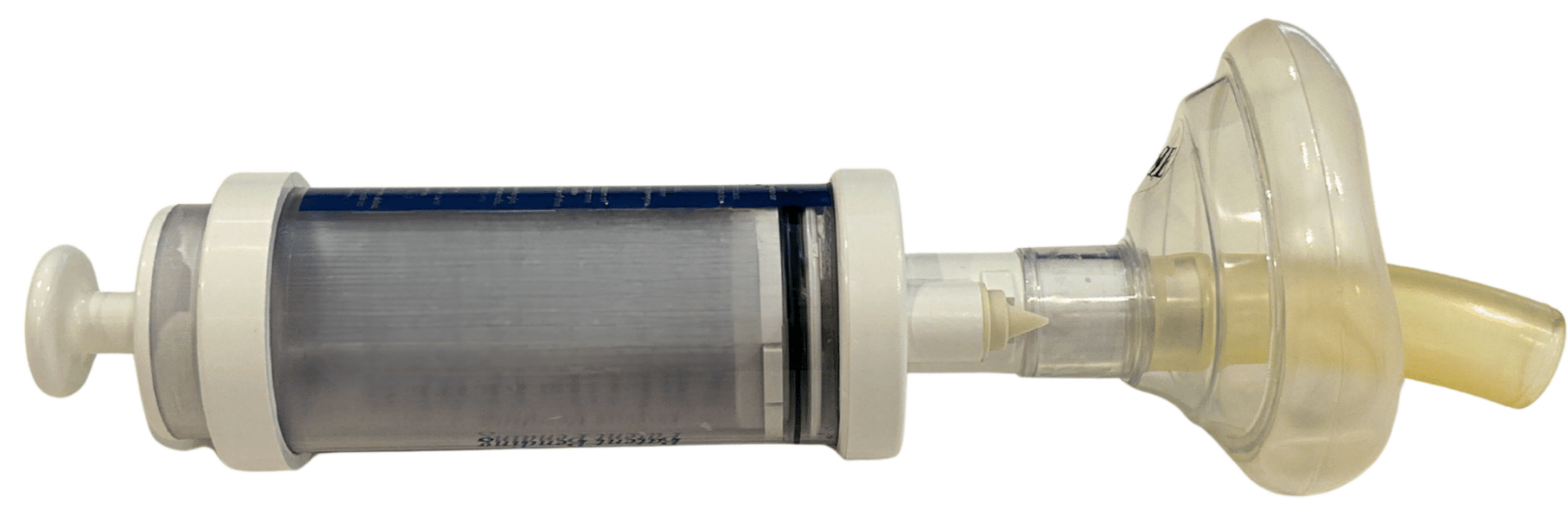
Unlike established techniques that can begin immediately, suction devices often require several preparation steps:
- Locating the device
- Opening the packaging
- Attaching the mask
- Trying to create an airtight seal.
As the FDA puts it, “the time to complete these steps and use an anti-choking device could delay use of established rescue protocols.”
There is very little high-quality clinical evidence
Many manufacturers advertise dramatic rescue stories and impressive success rates. These are not a substitute for well-designed clinical trials.
When the International Liaison Committee on Resuscitation (ILCOR) reviewed this question, it accepted only human clinical evidence, excluding manikin, cadaver and animal studies. For suction-based devices it found a single case series of ten patients — insufficient, it concluded, to support introducing a new technology with an associated financial cost, and insufficient even to give preliminary data on harm.
The very high success rates quoted in advertising come almost entirely from manikin studies. Tested on human cadavers the picture changes sharply: a 2023 study removed neither a grape nor a nut in any trial, and a 2025 study of three cadavers, following the manufacturer’s own technique, succeeded in one of twenty-one attempts. On the cadaver with no teeth no mask seal could be formed at all. This is highly important because older people are mostly likely to choke and often do not have all their teeth.
Success depends entirely on that airtight seal. Given these devices with nothing but the manufacturer’s leaflet, 43.1% of parents and kindergarten teachers failed to keep the mask fixed to the face with one device and 33.3% with the other. The impressive real-world totals you may see quoted are voluntary reports from people for whom the device appeared to work; there is no record of the times one was used and failed.
In fairness, the evidence for back blows and abdominal thrusts is also of low certainty, and thrusts carry their own risk of injury. The difference is that back blows and thrusts are always with you. There is nothing to find, unpack, assemble or seal to a face, and nothing to buy. You can start the moment you realise someone cannot clear their own airway. With irreversible hypoxic damage possible within a few minutes, that immediacy is the whole point
They can cause injuries
The FDA has received reports of:
- Bruising around the face, lips and mouth, scratches to the back of the throat
- Devices failing to generate enough suction to remove an obstruction
- The 2023 cadaver study also recorded a laceration to the tongue, with bruising and swelling of the tongue and soft palate.
The devices themselves are large and particularly frightening to present to a choking child.
Counterfeit and unregistered devices are an additional danger
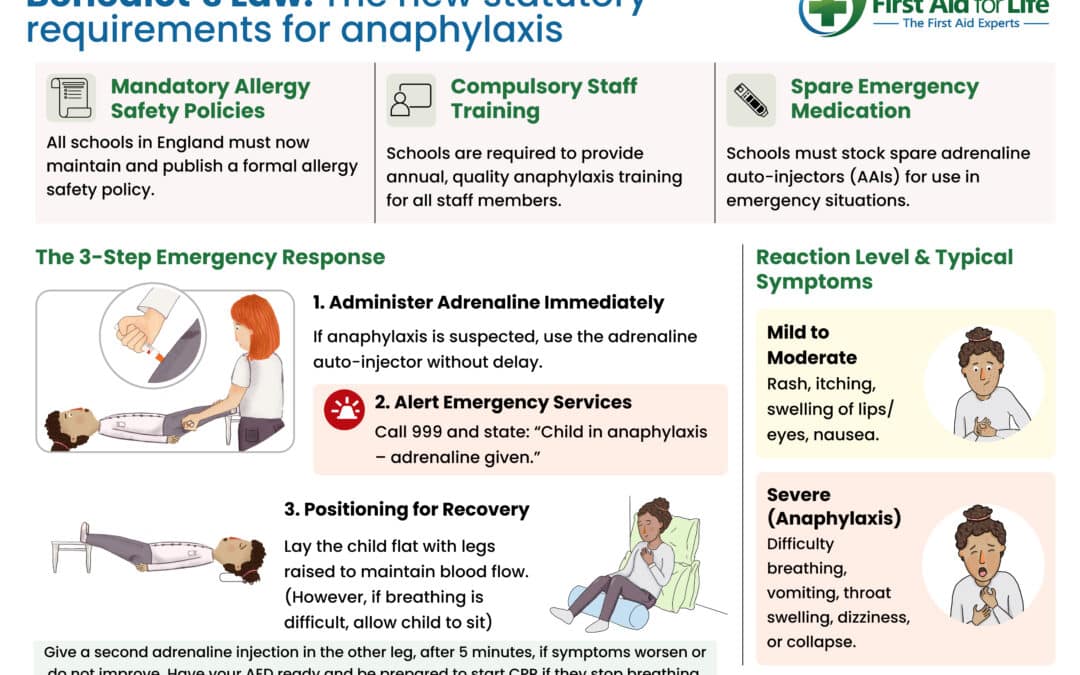
Many suction devices are now being promoted as essential first aid kit for nurseries, parents and care homes. In addition, those bought through online marketplaces may be counterfeit or unregistered copies. An unregistered device has not even completed the administrative step described above and may not comply with UK medical device regulations. These devices could prove dangerous.
Marketing claims are not independently verified
Some nurseries and care homes have been given the impression that they could be considered negligent without one of these devices on site. That is not the case. Mandatory first aid training should clearly cover how to help in a choking emergency, and these devices do not appear in any UK first aid algorithm.
The concern is not new. A 2020 systematic review in Resuscitation noted that websites promoting these devices were “actively advising people that it is okay to diverge from their first aid training because their product is registered as a medical device”, and warned that instructors teaching outside their published course guidelines “could be exposed to risk in the event of a negative outcome”.
What should you do instead?
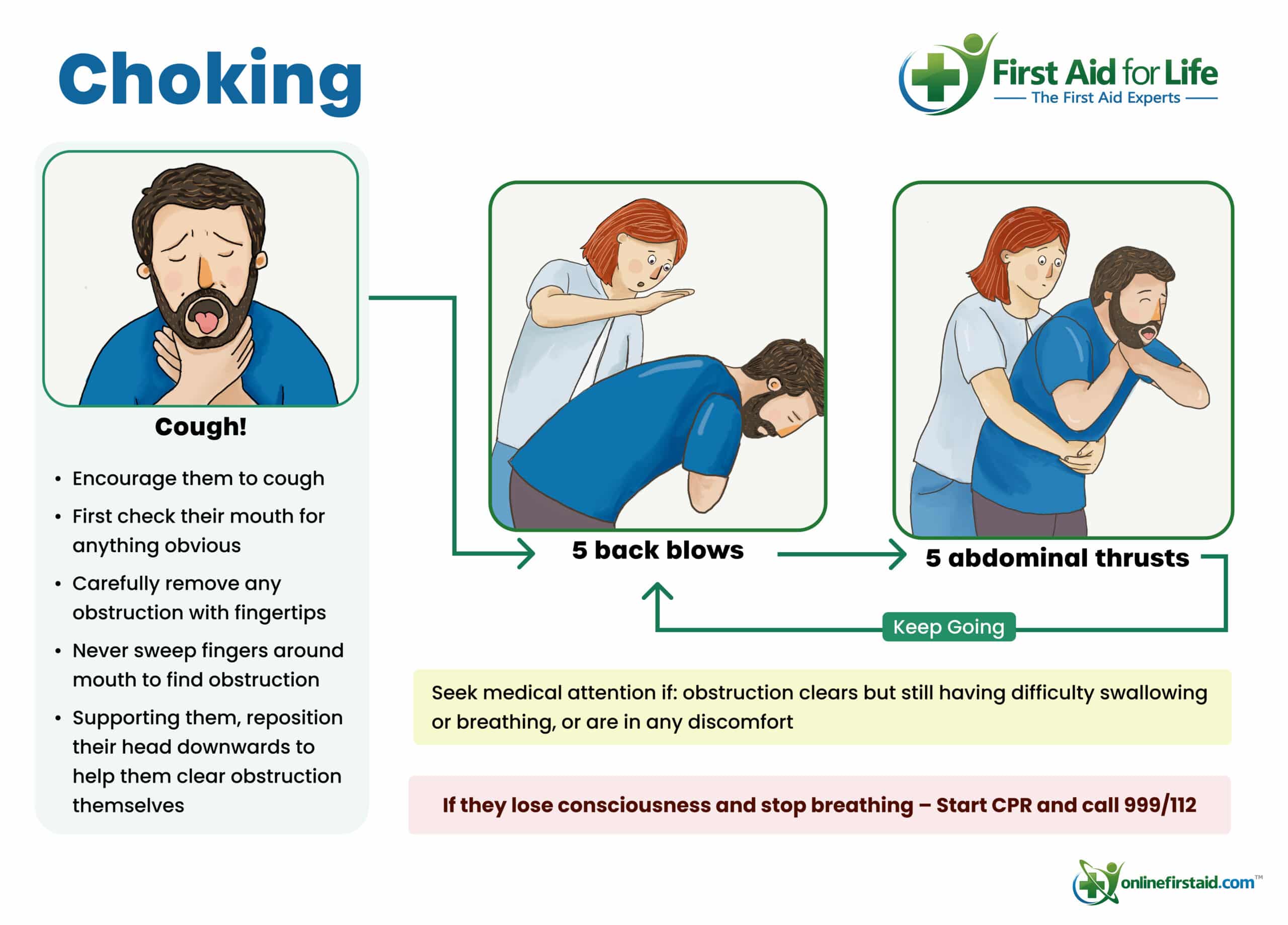
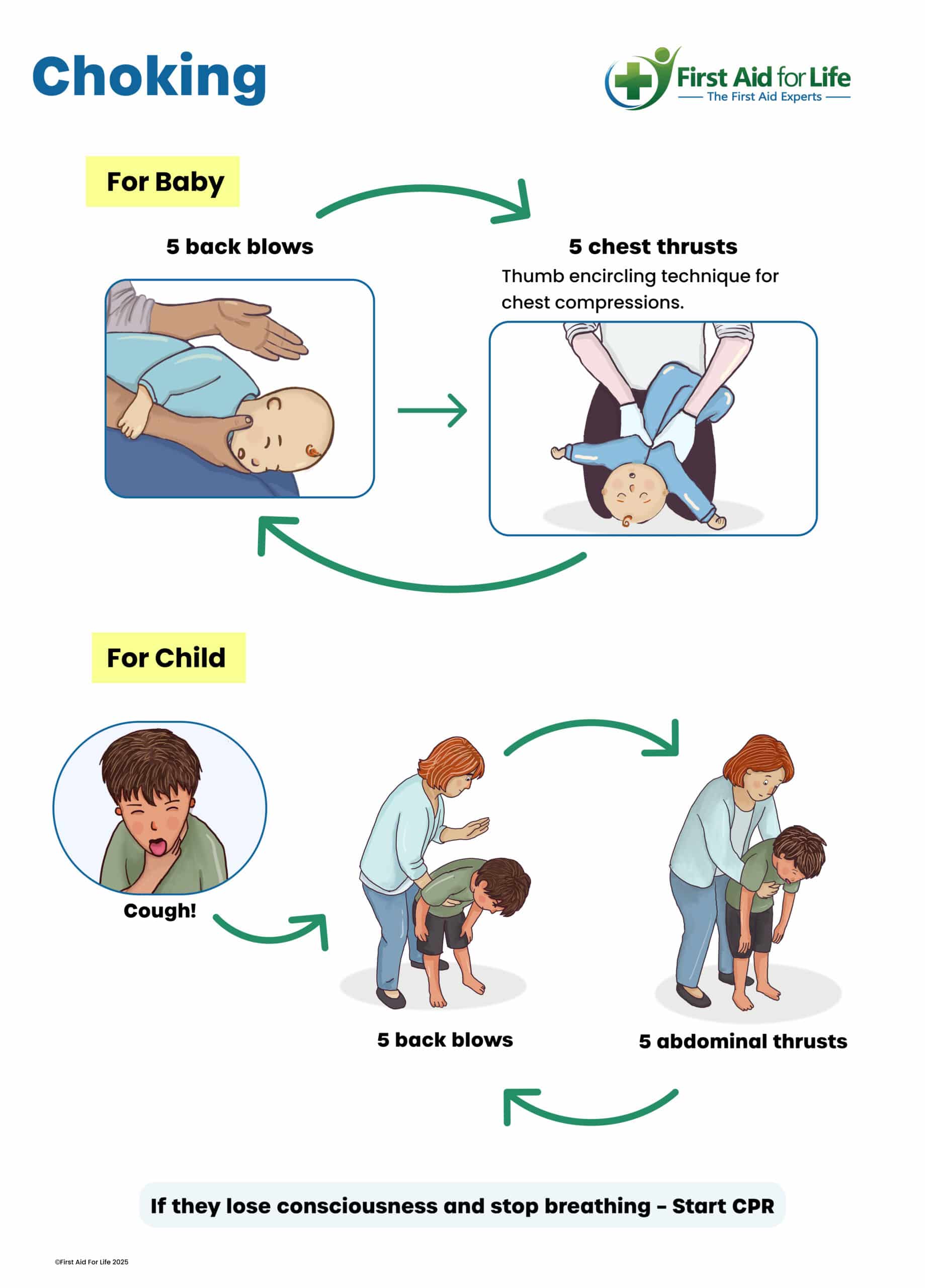
Follow established NHS and First Aid for Life guidance:
- Encourage effective coughing.
- If the coughing becomes ineffective and they cannot breathe, speak or cough, get someone to call 999 straight away. Do not wait for them to become unconscious.
- Give up to five back blows.
- If needed, give up to five abdominal thrusts (or chest thrusts for babies under one year).
- Alternate between back blows and thrusts until the obstruction clears or the casualty becomes unconscious.
- If they become unconscious, make sure 999 has been called and begin CPR immediately.
For a more detailed explanation read our article: First Aid For Choking Adults, Children & Babies.

If you already own one of these devices
Keep it – we are not telling anyone to bin theirs. Just be clear where it belongs in the sequence. Cough first; then back blows; then abdominal thrusts; call 999 as soon as the choking is severe. A device comes after all of that, if at all.
Advanced techniques belong in hospital
Healthcare professionals may use specialist suction equipment, laryngoscopy and forceps in controlled clinical settings. These are not comparable to consumer anti-choking devices.
In summary
Suction-based anti-choking devices should not replace recognised choking first aid. RCUK makes no recommendation either way and continues to prioritise established treatment. The FDA has authorised one device only as a second-line treatment, and requires its manufacturer to investigate whether using it delays basic life support. Registration, certification and CE or UKCA marking are not evidence of effectiveness. Learning recognised choking first aid remains the best way to help someone in a choking emergency.
Don’t wait for an emergency to realise you need hands on skills. We offer a completely free choking course to give you the confidence to act quickly, safely, and effectively.
References
- Kaizen Consulting and Training. Anti-choking devices: registration is not evidence.
- Resuscitation Council UK.
- Medicines and Healthcare products Regulatory Agency.
- MHRA registration correspondence
- London Ambulance Service NHS Trust.
About Us
First Aid for Life provides guidance and it is not in any way a substitute for medical advice. First Aid for Life is not responsible or liable for any diagnosis made, or actions taken based on this information. It is advised that you attend a First Aid course to understand what to do in a medical emergency.
First Aid for Life offer tailored first aid courses for specific activities and destinations.
Written by Emma Hammett from First Aid for life
www.firstaidforlife.org.uk


Thank you Emma.
I hear more and more about these devices from course participants. They are very aggressively marketed on social media sites.
I hold the UK Resus council guidance line but, out of curiousity, I bought one and tried it out in a manikin ( as their promo video depicted).
It was useless.
I now respond to delegates who mention theses devices with my own informed observation of the lack of efficiency.
The only place we ever used suction devices was when I worked in a MA respite centre… and that was part of a nursing protocol.
Sorry typo… MS respite centre