

Men B vaccine – why it is so important
Meningitis
Useful Links: Meningitis Research Foundation http://www.meningitis.org/ and to Meningitis Trust http://www.meningitis-trust.org/?gclid=CMWn4IzD87ICFeTHtAodunsAkA
Meningitis is swelling of the Meninges; the protective membranes of the brain and spinal cord, the inflammation usually results from an infection.

A meningitis vaccine is currently part of the routine immunisations but it doesn’t cover all available strains.
Men B vaccine – why it is so important:
Meningococcal Group B is the most common cause of Meningitis and we are still waiting for the vaccine to be routinely available on the NHS.
Meningitis B is currently responsible for the following:
1761 cases of MenB in UK per year
10% of survivors will have a major disability including amputations, brain damage and hearing loss
33% of survivors will have minor deficits including psychological disorders & reduced IQ
Meningitis and Septicaemia can happen to anyone of any age, but babies and toddlers account for 50% of cases and adolescents too, are often particularly at risk.
Meningitis is usually bacterial or viral, and occasionally is due to fungal infections, although almost any microbe can cause it.
Viral meningitis can be very unpleasant but is rarely life threatening and most people make a full recovery.
Bacterial meningitis is more serious and can be caused by a range of different bacteria.
Meningitis and Septicaemia (Sepsis) can be hard to recognise at first as early symptoms are similar to flu and other common illnesses.
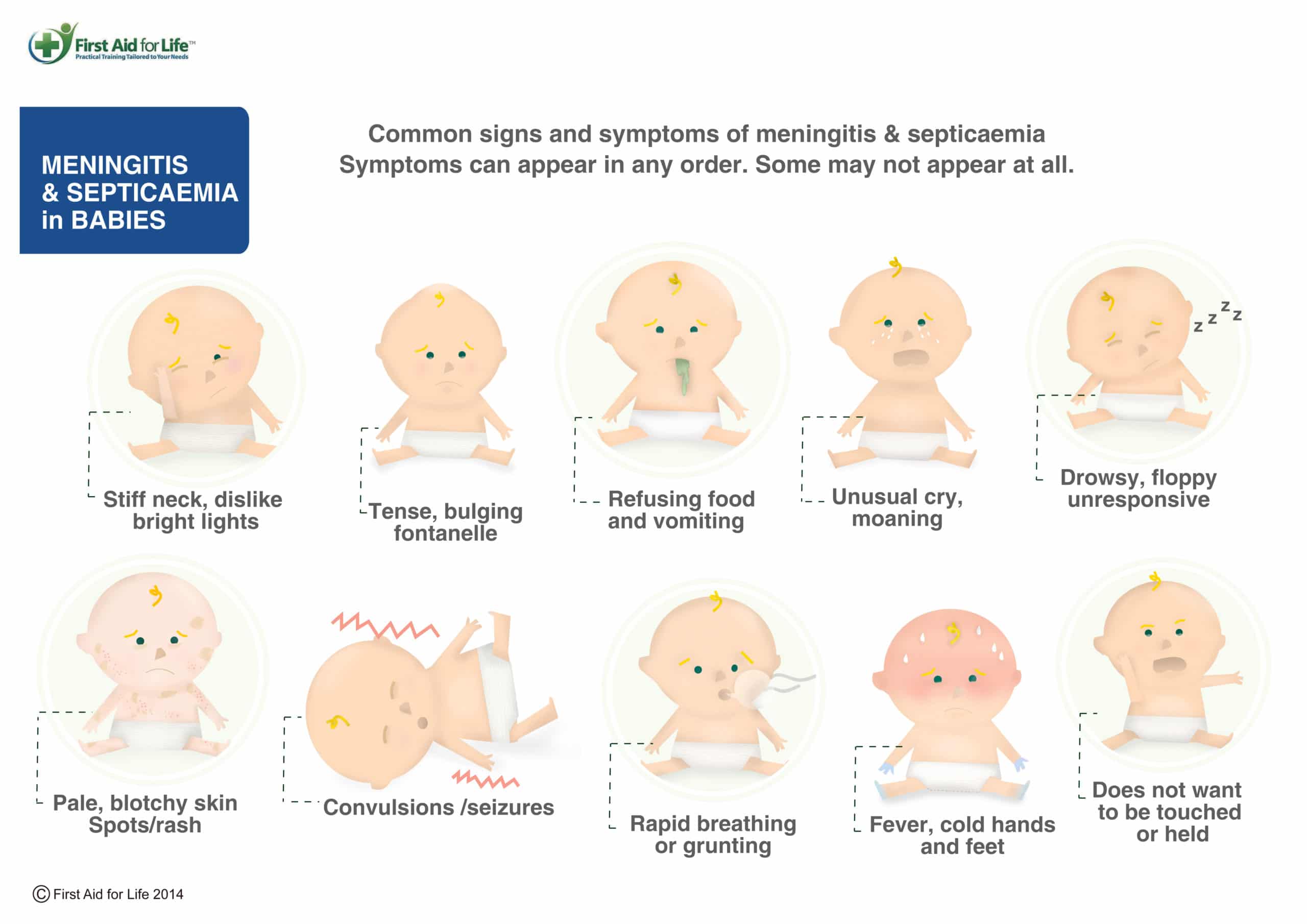
Key signs of meningitis to look out for in babies and children:
- Pale, mottled skin.
- Cold hands and feet
Symptoms can appear in any order, but the first symptoms are usually:
Fever – particularly with cold hands and feet, vomiting, headache and feeling generally unwell – these early symptoms are extremely difficult to recognise as they are similar to many other milder illnesses.
- They may have a headache and in small babies the soft spot of their head (fontanelle) could be raised.
- They may have vomiting and diarrhoea and difficulty breathing
- Floppy, lifeless and drowsy
- A rash may not appear at all – but if the person is unwell and you see a rash which does not disappear when pressure is applied to it (the tumbler test) – CALL AN AMBULANCE

Other meningitis symptoms specific to toddlers and babies:
- Refusing to eat/feed
- Irritable, not wanting to be held/touched
- A stiff body, with jerky movements, or floppy, unable to stand up
- A tense or bulging soft spot on the head (fontanelle)
- A high pitched or moaning cry
Meningitis rash and the tumbler test DO NOT WAIT FOR A RASH
With most rashes, when pressure is applied to the skin, the rash disappears. With meningitis, the rash is different and does not disappear with pressure and so can be seen when a clear glass tumbler is pressed over the skin (the tumbler test)


Meningitis research foundation pictures
It can be harder to see a rash on dark skin, check the soles of the feet, palms of hands, roof of mouth and inside eyelids
Meningitis can kill in 4 hours
When to call an ambulance
- If the casualty is getting worse and you are seriously concerned
- Call an ambulance if you see a rash begin to appear and you are still able to see it if you apply pressure with the side of a glass.
- If they are seriously unwell and have some of the above symptoms
Call your GP – if you cannot get to talk to the doctor immediately – get the casualty to hospital or phone an ambulance
If you are sent home from the hospital or GP Surgery and the child gets worse. Return again. Trust your instincts and tell them you are worried!



0 Comments