
Practical First Aid
First Aid for Children in School

Time: You Choose
Certificates available
Taught by Experts
Summary:
Learning first aid is an invaluable life-skill. It helps children become more risk aware and equips them with skills to keep themselves safe and help themselves or others if involved in a medical emergency. It could save their life.
First Aid for Life is a multi-award-winning, fully regulated First Aid Training provider, working in partnership with hundreds of schools since 2007. We will tailor our training to your needs and the requirements of your pupils and to your budget too – we can teach as part of PHSE, link it to some other part of the curriculum, in preparation for a school trip, or around any other particular need.
Our trainers are highly experienced (DBS cleared) medical and emergency services professionals who are superb at providing engaging practical training to adults, children and young people.
From September 2020, first aid training will be a mandatory part of the English PSHE curriculum. In light of this we have created an incredible range of helpful age-appropriate resources to help you introduce your students to this complex subject.
The best way to teach first aid is hands-on. Students love the practical nature of this subject and the wealth of experience our medical and emergency services professionals are able to share.
We have created a comprehensive set of resources and teaching materials around the recovery position – which you can access totally free.
Full access to the rest of our downloadable teaching resources and the age appropriate modular online courses is free when you book any group practical first aid training with us for your staff, parents or students.
We are First Aid Experts specialising in providing engaging, informative, practical first aid training for staff, parents and pupil in schools and child care organisations.
Latest Government Guidance:
First Aid for Schools, EYFS Framework and Ofsted Childcare Register can be viewed here:
- BJSN Article by Emma Hammett: Fulfilling the first aid requirements in schools
- Statutory Guidance on Supporting Pupils at School with Medical Conditions
- Guidance on First Aid for Schools
- Paediatric First Aid Requirements for Early Years Foundation Stage: Consultation June 2016
- Guide to Registration on the Childcare Register: Ofsted Guidance
Teaching Resources:
First Aid Videos
For a playlist covering all Primary and Secondary School topics, click here or on the button below.
These videos cover every topic in our full Secondary School syllabus:
- Recovery position
- CPR
- Choking
- Anaphylaxis
- Asthma
- Bleeding
- Burns
- Head injuries
- Seizures
There are hundreds more videos covering many more first aid topics on our YouTube channel. We put up two new videos every week.
Subscribe to our channel by clicking here.
Details:
Learning first aid makes children more aware of risks and gives them the skills to stay safe and help in emergencies. First Aid for Life has been working with schools since 2007 to offer award-winning, flexible training led by experienced medical and emergency professionals. They provide hands-on lessons along with free teaching materials and online modules designed to meet the PSHE curriculum requirement from September 2020.

In the Press:
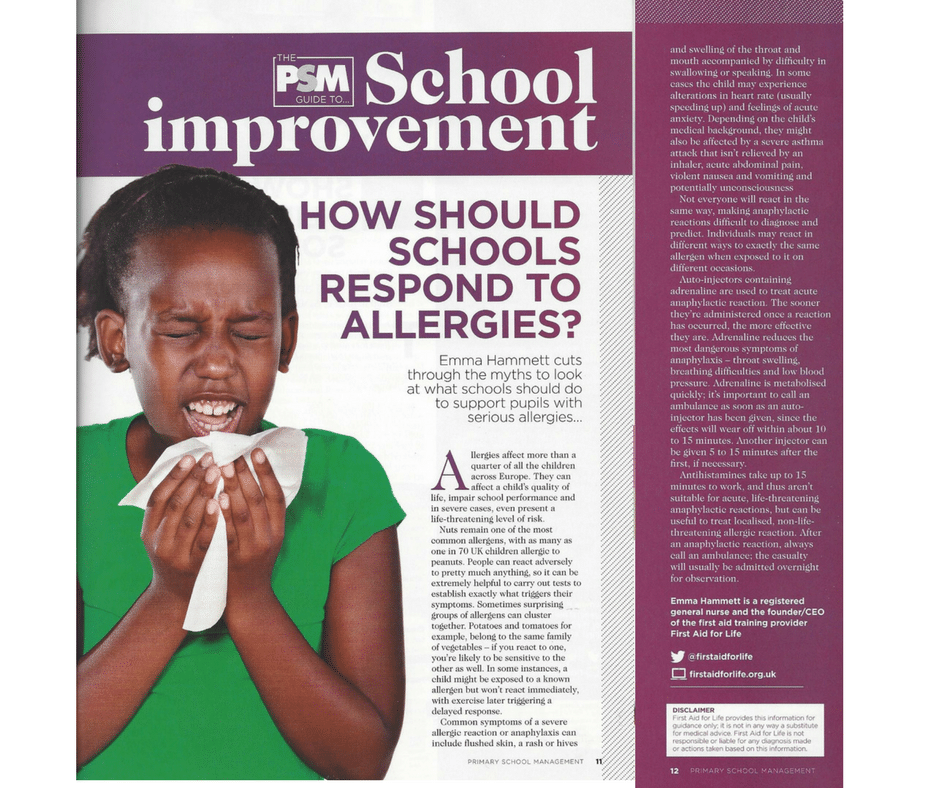
Some of our most relevant articles to help you with the first aid requirements in your school:




Useful Blog Articles

Breaks, Sprains and Dislocations – What you need to know
We all know someone who has experienced a break, sprain or dislocation. From skiing, slipping whilst running round the side of a swimming pool, trampolining ... or just falling badly, they happen all the time, and they are tricky injuries to avoid. Whilst breaks and...

Head Injuries in Children and Bloody Noses
Head injuries Children also frequently bang their heads and it is difficult to tell whether or not they have done any serious damage. Although, most head injuries are not serious and simply result on a bump or bruise. However, severe or repeated head...

Staying Safe on Sports Day
It’s that time of year when schools the length and breadth of the country get ready to enjoy Sports Day. It’s a great day for the teachers organising it, the kids taking part and the parents proudly watching on. However, with so much going on in a highly competitive...